
I used to take notes during demo calls. A pad on the left, the screen share on the right, me trying to be present and useful and also writing fast enough that I would not forget the thing I just promised to do.
I was never any good at it. If I wrote down “send login,” I missed the next sentence. If I stayed in the conversation, the “send login” turned into a vague memory of “I think I agreed to send him something.” Twelve hours later, in the shower, I would remember three different commitments from three different calls and have no idea which one belonged to which person.
So I stopped. Now I do not take notes during calls at all. I just show up and talk. The notes happen afterward, and they happen in a Claude Code session.
Here is the pattern.
During the call: nothing
No pad. No open doc. If a date needs to go on the calendar in the moment, I put it on the calendar in the moment, and that is the only writing I do. Otherwise I let the whole call be a conversation.
The one thing I do is hit record if the other person is fine with it. Most of the time they are. If they are not, I make do with memory, which is worse but still workable because of what happens next.
After the call: one prompt
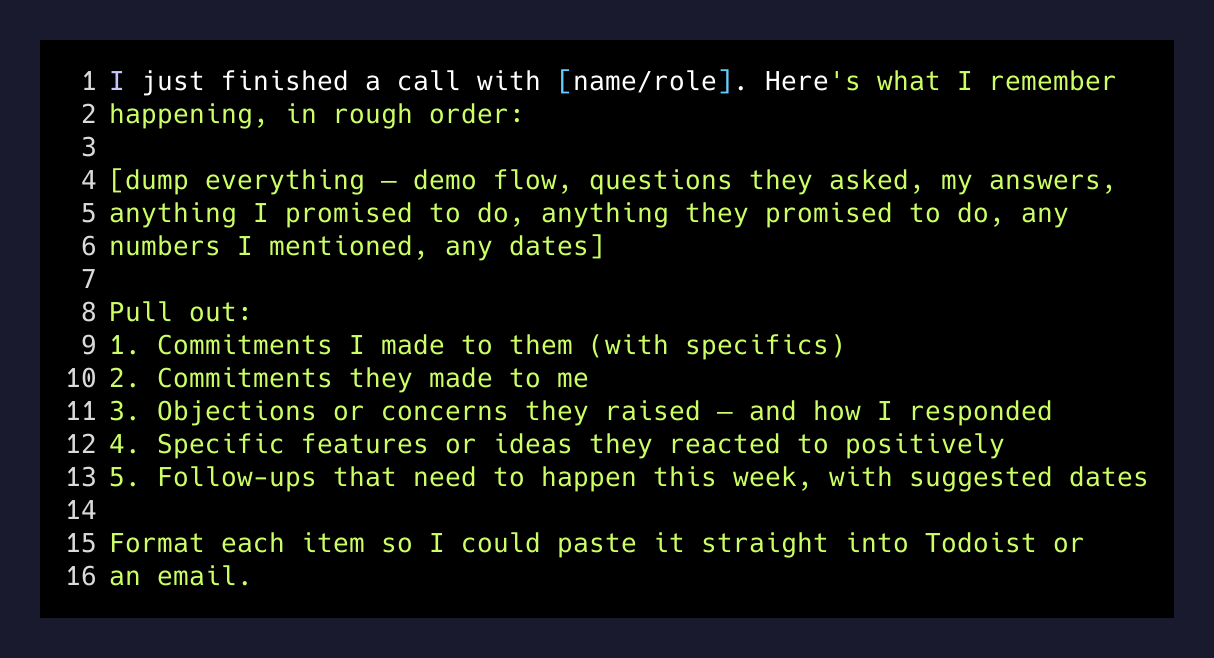
As soon as the call ends I open a Claude Code session in the vault folder for that relationship and run this:
I just finished a call with [name/role]. Here's what I remember
happening, in rough order:

[dump everything — demo flow, questions they asked, my answers,
anything I promised to do, anything they promised to do, any
numbers I mentioned, any dates]

Pull out:
1. Commitments I made to them (with specifics)
2. Commitments they made to me
3. Objections or concerns they raised — and how I responded
4. Specific features or ideas they reacted to positively
5. Follow-ups that need to happen this week, with suggested dates

Format each item so I could paste it straight into Todoist or
an email.
That is it. One session, one dump, one prompt. The output is a structured block of follow-ups I can act on tomorrow morning without re-remembering anything.
Why this beats taking notes
The core trade is attention vs. capture. During a call you can only do one well. If you optimize for capture, you lose the thread of the actual conversation, and the person on the other end feels it. They watch you type and they talk slower, or they skip the nuance because they do not trust that you are listening. If you optimize for attention, you lose every detail that is not “write down the date.”
A recording plus a replay prompt gives you both. The attention happens in real time. The capture happens from the recording, which is more accurate than my notes ever were, and the structuring happens from the prompt, which is more consistent than my after-call cleanup ever was.
What the output actually looks like
For a thirty-minute demo call, the output is usually twelve to twenty bullets. A handful of commitments I made. A couple of commitments they made. Two or three objections with my responses captured verbatim-ish. Four or five features they reacted to strongly. And a follow-up list with suggested dates, formatted so I can copy a line into Todoist and it will parse.
The call is for the conversation. The write-up is for the follow-through. Trying to do both at once makes you bad at both.
— the rule
A specific thing I like: the model will catch commitments I did not consciously register making. “You said you would get them a login this week” — oh, right, I did. That phrase slipped out around minute eighteen and I forgot by minute twenty. The dump contains it because I describe the whole arc of the call, and the model notices the verb “get them a login” sitting next to a person on the other end of a conversation and flags it as a commitment.
The failure mode
The failure mode is thinking of the model as a transcription service. It is not. It is a structurer. If you hand it a verbatim transcript with no framing, you get back a wall of text. If you hand it your rough recollection with a prompt that asks for specific structures, you get back something you can act on.
So the quality of the output is bounded by the quality of your dump. The dump does not need to be clean, but it needs to be complete. The ten things you can remember beats the two things you wrote down.
The bigger idea
Taking notes during a call is not really about capture. It is about proving to yourself that you are paying attention. The pen moves, so you must be listening, so the call must be going well.
The pen moving is not the same as listening. Replacing it with a replay prompt is admitting that the two were never the same, and that one of them was the real work.
I run this prompt after every call now — demos, strategy conversations, even the occasional personal call where I need to remember what I said I would do. The call is for the conversation. The write-up is for the follow-through. Trying to do both at once was the thing making me bad at both.