
Most people use a calendar to figure out where they are in the week. I used to do that. Then I noticed something: the calendar tells you when it is, but it never tells you what kind of day it is. A Sunday and a Tuesday look identical on a grid. They’re not.
So I built one slash command per cadence. My week is a stack now.
The stack
/pagoodmorning   every morning   — what's today, what's hot, what's loose
/paflow          any work block  — pick a task, log start, work, log stop
/pajournal       evening         — reflect, capture, faith-centered prompt
/pafriday        end of week     — what shipped vs planned, weekend prep
/paweekly        Saturday        — score the week, surface stale tasks
/pasunday        Sunday evening  — preview the week, pick the 3 wins
That’s it. Six commands. They all live in ~/.claude/skills/pa*/SKILL.md and they each do exactly one thing.
The trick isn’t that any of these commands is clever on its own. The trick is that each one knows what time of week it is and asks me a different question because of it.
Why one command per cadence
I tried the alternative first. One big /pa command that did everything — “tell me what’s going on” — and tried to be smart about which mode to enter based on the day of the week.
It was bad. It hedged. It would do a half-morning-briefing on a Sunday because it wasn’t sure if I wanted prep-mode or briefing-mode. Branching on day-of-week inside one prompt produced a tool that was always 70% right and never 100%.
Splitting them was the unlock. Each command gets a hyper-specific brief:
/pagoodmorningis read-only on tasks and calendar. It never modifies anything. It just summarizes./pasundayis allowed to write to Google Tasks because Sunday is when you set the week./paweeklyis the only one allowed to touch Search Console data, because the weekly score includes traffic for the sites I run./pafridayis intentionally lighter — it doesn’t try to plan next week, just close this one.
Here’s a real example. The frontmatter on pasunday/SKILL.md:
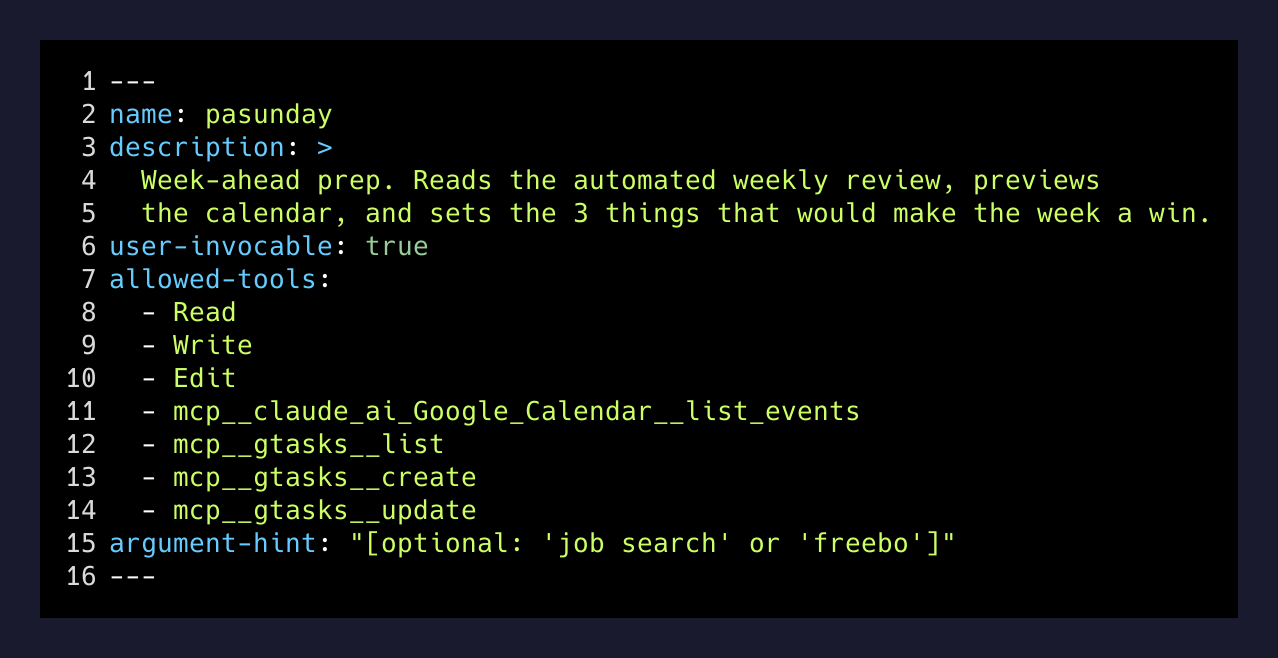
allowed-tools is the contract. Sunday gets to create and update tasks. Morning briefing doesn’t. The constraint isn’t a limitation — it’s the whole reason the briefing is calm. It can’t decide to “helpfully” reschedule something while I’m reading it.
What the cadence actually does to my brain
Before this stack: I’d open my laptop on a Tuesday and do a vague mental scan. What was I in the middle of? What’s overdue? Did I follow up on that thing? Some days I’d remember. Some days I wouldn’t.
After: I type one of six things and the right question shows up.
- Tuesday morning:
/pagoodmorning— calendar, action-required emails, 3 hot tasks. 30 seconds to read. - Tuesday after lunch:
/paflow— pick the next task, log a start time, go. - Friday at 4pm:
/pafriday— what got done this week vs what I said I’d do. Honest. - Sunday at 8pm:
/pasunday— read the auto-generated weekly review, look at next week’s calendar, pick three things that would make it a good week.
The Sunday command is the most valuable one. It reads the weekly review that another agent wrote at 6am Saturday, so by the time I sit down Sunday evening, the analysis is already done. I just have to decide.
The thing nobody talks about with personal automation
You don’t actually want your assistant doing more. You want it doing the same things, on schedule, without asking. The win isn’t capability — it’s predictability. I know that at 5am tomorrow, a context map will be sitting in Daily/2026-04-27-context.md. I know /pagoodmorning will pull from it. I know /pasunday will give me three priorities, not seventeen.
That predictability is what turns a pile of slash commands into something that actually shapes a week.
The cadence is the product. The skills are just the surface.
What I’d build next
If I were starting over, I’d add one more: /pamonth. A monthly retrospective that scores the four weeks, surfaces patterns I’d never notice from inside a single week, and asks one hard question about what I’m avoiding.
I haven’t built it yet because I’m not sure the cadence is right. Maybe it’s /paquarter instead — three months is enough time to actually see whether a project moved or just felt like it moved. A month might be too noisy.
That’s the question I’m chewing on this week. If you’ve automated your own life rhythm, what’s the longest cadence that actually changed your behavior? Daily is easy. Weekly works. I’m not convinced anything beyond that has ever made me do something different.
Tell me I’m wrong.