
A wedding showed up on my calendar last week. Charleston, August, two days blocked off.
By the time I sat down at my desk that night, my assistant already knew the average August temperature, the closest airport, and that the venue was twenty minutes from a hotel block I should probably book before May.
I didn’t ask it to do any of that.
I had been quietly building something I’m calling a trip primitive — a first-class data type in my personal assistant, the same way “task” or “note” is. Every multi-day calendar event with the right shape gets pulled into a folder, given a frontmatter schema, and handed off to a research pass that fires exactly once.
/patrips detectThat’s the whole user interface. The system reads my calendar, finds anything that smells like a trip, and either matches it to a note that already exists or creates a new one. Then it goes shopping for context.
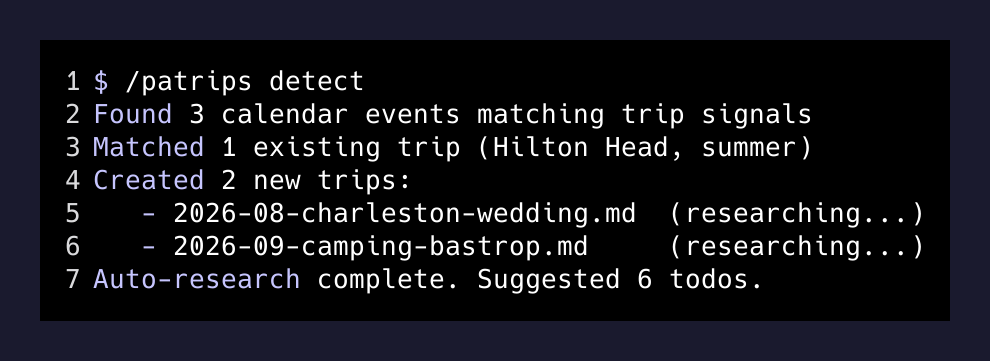
The interesting part isn’t the automation. It’s that I stopped thinking of trips as events on a calendar. They became things the system can reason about. Camping trips trigger a different research path than weddings. Funerals trigger a different one than bachelor parties. The skill knows the difference because I told it once.
What I didn’t expect: the moment trips became objects, every other part of my assistant got smarter about them. My morning briefing started flagging “you leave for Hilton Head in 47 days, no lodging booked.” My task tool started suggesting checklists. The journal noticed when I came back.
I’m building toward something where my whole life is structured the same way — not as files, not as notes, but as types my assistant understands. People have names and relationships. Trips have dates and attendees. Projects have stakes and deadlines.
Once the shape is right, the assistant stops being a chatbot and starts being a system.
I’ll show you what’s underneath soon.