
Every Sunday at 6 PM, a retrospective gets written. Tasks completed, posts published, ideas captured, things that broke. It reads like something a diligent project manager would produce after interviewing the whole team.
Nobody writes it.
OnCalendar=Sun *-*-* 18:00:00A systemd timer fires. An agent crawls the week’s activity — daily notes, session logs, vault changes, cron output — and stitches together a narrative. Commits a Markdown file. Done before dinner.
This week’s review clocked in at about a hundred lines. It noted that an LLC was filed, a workshop got scaffolded from scratch, a content sprint was locked in with a collaborator, and five blog posts went live. It flagged a billing failure that’s been quietly compounding for weeks. It logged that four tools got used for the first time since they were built.
Then it graded itself.
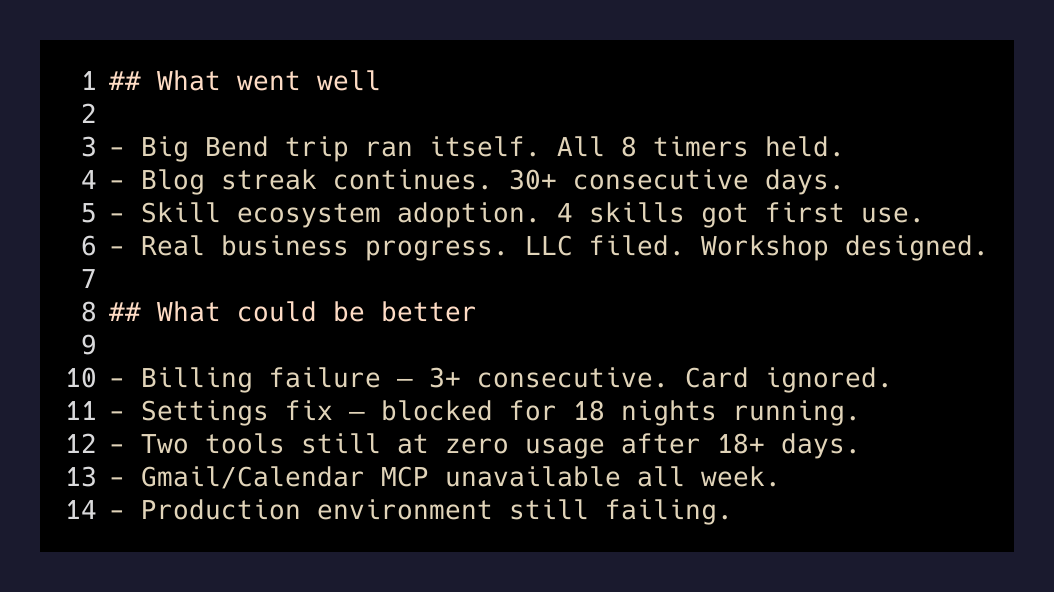
The “what went well” section runs five bullets. “What could be better” runs six. More criticism than credit. And the criticisms aren’t vague — they’re specific counts, exact durations, named failures. The system doesn’t soften its own edges.
The part that got me: somewhere in the review, the system praised its own reliability. All eight scheduled automations ran flawlessly through a stretch where I was completely unreachable. Morning briefings. Blog publishing. Self-improvement cycles. Everything held. Then, in the very next section, it listed what it still can’t do.
A retro that celebrates its uptime and immediately confesses its limitations. Written by software, about software, for a human who wasn’t there to observe any of it.
# vault: 656 files | blog streak: 30+ days
cat "Daily/2026-W16-weekly-review.md" | wc -l
# 99
I read it Monday morning. Most of it I already knew. But a few things surprised me — and the surprises were all in the criticism section. The uncomfortable truths I hadn’t been tracking showed up in bullet points I didn’t write.
There’s a version of automation where you just make things happen faster. Then there’s this version, where the system keeps its own score and isn’t shy about the gaps. Where the most useful output isn’t the work it completed but the honest accounting of what it dropped.
I didn’t ask for self-awareness. I asked for a summary.