 Marketing & SEO
I’ve been thinking about reaction creators wrong.
For about a year I’d watch someone like @drewhawks pull up a Reddit thread, narrate the setup, then scroll into the comments and react to those. I’d nod, enjoy it, scroll on, and file it under “format I’m not going to copy because I’d feel like a hack.”
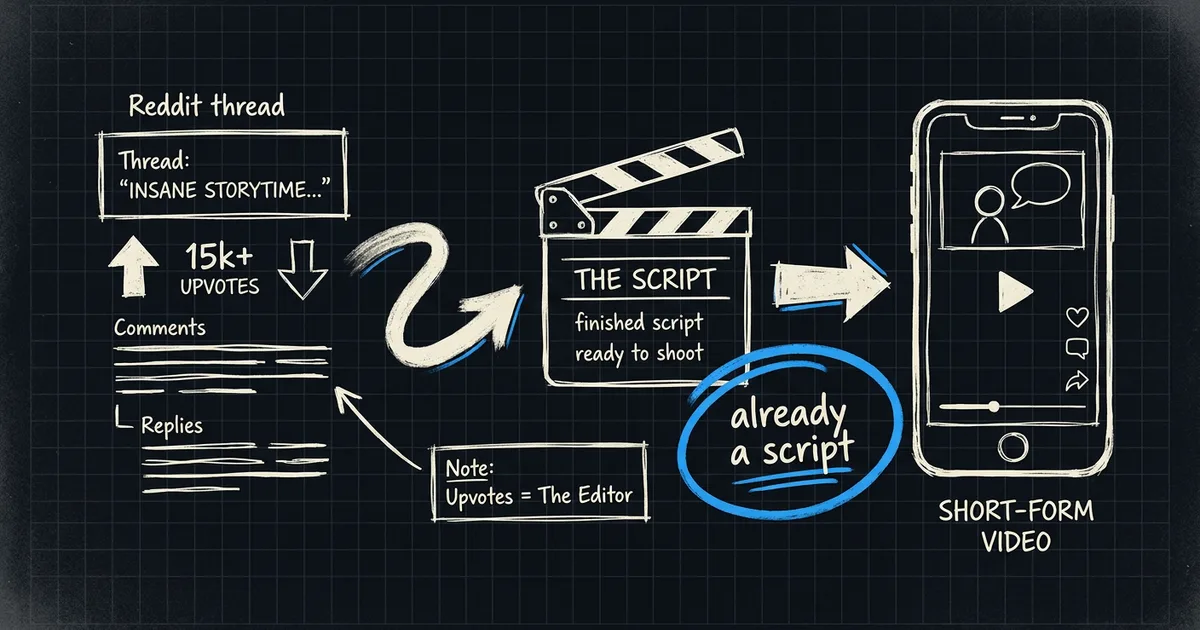
Then I caught myself rewatching a few of his videos to figure out why they kept landing. The framing was good. The takes were good. But the part I was actually responding to wasn’t the creator at all. It was the thread. The thread was already a perfect little story — setup, twist, drama, resolution — and the top comment was already the punchline somebody else’s brain had cooked all the way down.
That’s when it clicked. He’s not writing content. He’s picking content the crowd has already finished writing.
What “viral” actually means
A thread with 40k upvotes and 8k comments is not a prompt. It’s a finished product that got through the world’s most ruthless editing process.
Think about what had to happen for that top comment to be the top comment:
- Thousands of people read the post.
- Hundreds wrote a reply.
- Tens of thousands voted on the replies.
- One reply rose to the top and stayed there long enough that it’s still on top when you find it the next day.
That comment is not somebody’s opinion. It’s the consensus take, ranked by a distributed editorial team of strangers who don’t get paid and don’t know each other and don’t have a Slack channel. The vote count is the rubric. The position on the page is the score.
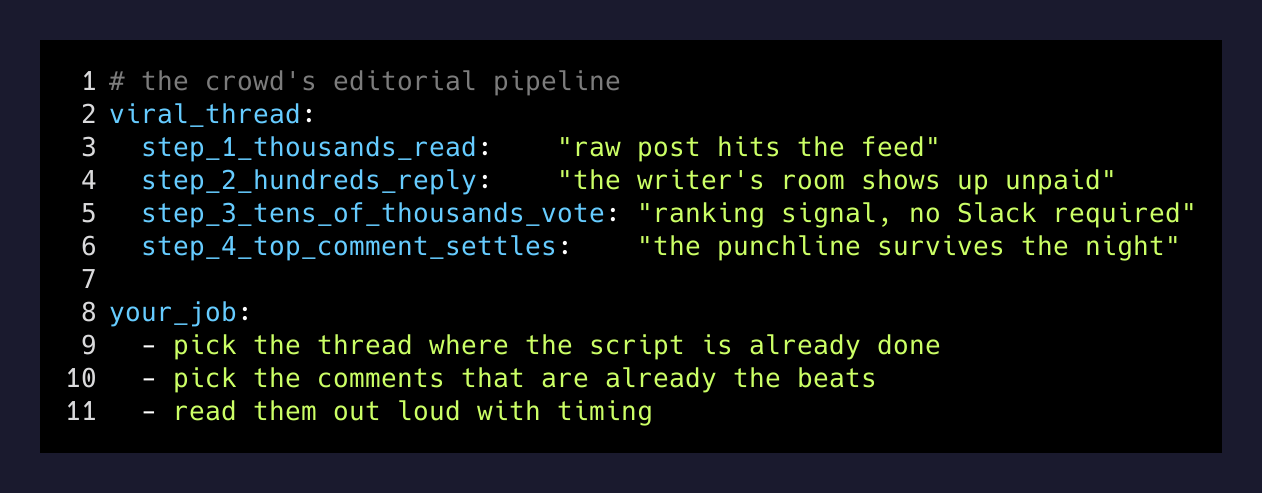
When a creator scrolls to that comment and reacts to it on camera, the work they’re doing is picking the right comment and delivering it with timing. The line itself was already optimized.
Upvotes are a free editor. Most of us are still writing our own scripts in a coffee shop.
— The format the crowd built
The part I find genuinely interesting
There is a version of every viral thread where the post and the top three comments together form a complete three-act short. Hook (the post). Reversal (the comment that reframes it). Button (the comment that’s just one line and makes everyone laugh).
You don’t have to write any of those acts. You don’t have to invent the premise. You don’t have to land the joke. The thread already did all of that. The only thing left to do is:
- Pick the right thread.
- Pick the right comments inside it.
- Read them out loud in the right order, with timing.
That’s the whole job. It’s a curation job dressed up as a creator job. The creators who are good at it are editors, not writers. They have taste for which thread is a finished script and which one is just busy.
This is also why the format travels. You can run this same loop on relationship advice threads, on AI subreddits, on news comment sections, on local Facebook drama, on anything with a visible crowd reaction. The format doesn’t care about the niche. The niche just changes which crowd is doing your editing for free.
The AI-assist isn’t where I thought it was
When I first sketched out a tool for this — and I am sketching one out — I thought the AI’s job would be to write punchier takes than the creator could.
That’s the wrong job.
The AI’s job is picking. Reading 200 threads in an afternoon, scoring which ones have a clean three-act shape, surfacing which top comments are already the punchline, and stacking ten of them into a recording queue so the human doing the read isn’t spending their best hour of the day scrolling.
You don’t need a model to write a hotter take than the crowd. The crowd already wrote the take. You need a model to be a casting director — find me the threads where the script is already done and the only thing missing is a voice.
What this changes for anyone making content
If you’re trying to grow a short-form channel and you’re staring at a blank doc trying to think of hooks, you are doing the hardest version of this on purpose. There are entire ecosystems of free, pre-edited, crowd-ranked story content sitting in plain sight. The only reason most people don’t use them is that they think originality means writing every word.
It doesn’t. Curation is a creative act. Reading something out loud with the right pause is a creative act. Picking which fifteen seconds of a thread to show is a creative act. The crowd writing the line for you doesn’t make your video less yours. It just means the writer’s room scaled.
The next time you watch a reaction creator and think I could do that, but I’d feel like I’m not really making anything — go look at the upvote counts. That’s the writers’ room. They already did the work. They’re not even asking for credit.
You just have to show up and read it well.