
I have been quietly building a small consulting offer around getting local businesses to show up in ChatGPT’s answers. Cabinet shops. Welders. Funeral homes. The kind of operator who has a website built in 2014, a Google Business Profile they haven’t touched in two years, and zero presence in any LLM’s idea of “best [thing] in Austin.” That is the gap. The product is to close it.
Yesterday afternoon I sat down with a working list of 20 niche ideas and a vague plan to “make a sales motion.” I got up six hours later with a 50-niche ranked list, three derivative niche lists, ten driving routes from my apartment, and fifteen personalized one-page pitch PDFs ready to print and hand-deliver. The whole sales stack. Built in one session.
This post is the receipts.
The opener I am leading with
Before any of the artifacts, the thing I want to talk about is the opening line. Because everything else is downstream of it.
I am not a famous agency. I do not have a deck full of case studies. I do not have a track record I can cite to a cabinet maker on Pond Springs Road. What I have is geography.
So the opener for Route 1 is literally:
“Hey — I live like a mile from here off Scofield Ridge. I help shops like yours show up when people ask ChatGPT ‘best cabinet maker in Austin.’ Wanted to drop a one-pager for the owner in case they’re curious.”
That is the pitch. “I literally live a mile from your shop” is not a humblebrag. It is the trust signal. Every other lead source these shops have ever heard from is a national agency cold-emailing them from somewhere they have never been. I am the guy who drives past their building on his way to H-E-B.
You do not need a case study to outflank a cold email. You need to not be a cold email.
The five-mile audit
Once I had the opener, the next move was to figure out who is actually in walking distance of my front door. Not “in Austin.” In my five-mile blast radius.
I asked Claude to enumerate the highest-density local clusters of cabinet shops, welders, metal fabricators, and funeral homes inside that radius, then route them. Out came ten 3-hour driving loops, each starting and ending at my apartment, each with seven or eight stops, each with a Google Maps deep link.
Route 1 is “Pond Springs Mile.” Stops 5, 6, and 7 are in the same business park — I walk between them. Total drive time, end to end, is half an hour. Total contact opportunities: seven independent operators, three of them with no website at all.
260 Scofield Ridge Pkwy (start)
 -> ProCabinetry          5400 W Parmer Ln       4.9 stars (18)
 -> Form Fabrication      6303 Jennings Dr        5.0 stars (4)
 -> Cabinetto             9518 Anderson Mill Rd   5.0 stars (111)
 -> Tru-Form Metal        13496 Pond Springs Rd   4.9 stars (7)
 -> Twisted Metals        13200 Pond Springs Rd   5.0 stars (5)
 -> Peglar's Custom       13200 Pond Springs Rd   4.9 stars (11)
 -> Austin Mortuary       13200 Pond Springs Rd   5.0 stars (4)
260 Scofield Ridge Pkwy (end)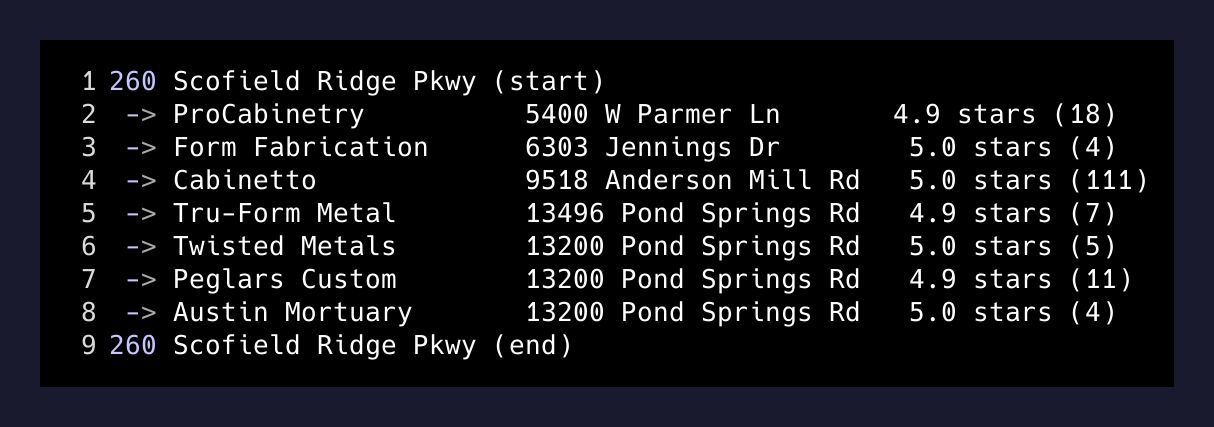
Route 2 is the funeral home loop, eight stops, all independent or independent-feeling locations of small chains. The decision-maker is, with high probability, in the building. There is no SDR. There is no marketing manager. The director runs the marketing.
That is the entire reason I am doing this in person instead of with email. The exact same pitch, sent cold, gets filtered. Walked in, with paper, by the guy who lives down the road, gets read.
The PDF I am leaving behind
Each stop gets a one-page PDF on standard office paper. Hand-tailored. The personalization is the point.
The build path: WebFetch the business’s actual site, read what they say about themselves, find the real signal — a five-step process they brag about, an “only on-site crematory in Travis County” claim, a 4.9-star rating with 18 reviews and zero web presence. That signal goes into a config file, the config file goes into a Python template, the template emits a print-ready single-page PDF.
The PDFs are all named like this:
Drop PDFs/
  r1-01-procabinetry.pdf
  r1-02-form-fabrication.pdf
  r1-03-cabinetto.pdf
  r1-04-tru-form-metal.pdf
  r1-05-twisted-metals.pdf
  r1-06-peglars.pdf
  r1-07-austin-mortuary.pdf
  r2-01-cook-walden-capital-parks.pdf
  r2-02-affordable-burial-cremation.pdf
  r2-03-all-faiths.pdf
  r2-04-austin-peel-son.pdf
  r2-05-austin-cremations.pdf
  r2-06-cook-walden-flagship.pdf
  r2-07-weed-corley-fish.pdf
  r2-08-cook-walden-chapel-of-the-hills.pdf
Fifteen PDFs. Fifteen distinct headlines. Fifteen “what I noticed about your business” callouts referencing things I actually saw on their site or in their Maps profile.
Headline for the cabinet shop with eighteen 5-star reviews and no website? “Eighteen people love you. ChatGPT has never heard of you.” Headline for the welder by appointment only? “Your shop runs on referrals. ChatGPT users are the referrals now.” Headline for the funeral home whose name literally describes the search? “Your name describes the search. You are missing from the answer.”
Each PDF has the same skeleton: an eyebrow that says FOR [BUSINESS] from BRETT, NORTH AUSTIN; the personalized headline; a short lede; a ChatGPT mockup card; an observation paragraph; a three-card play row; a proof line; and a black CTA box with a QR code to my booking calendar.
The detail I am most proud of
The ChatGPT mockup card is the part that took the longest to get right.
I did not want it to look like an ad. I wanted it to look like a screenshot.
That sounds tiny. It is not. The default impulse, when you are designing a sales artifact, is to make the artifact look good — drop shadow, gradient, brand color, a logo. All of that screams somebody is selling me something. Which is exactly the wrong vibe for a piece of paper getting hand-delivered to a guy who has not opened a marketing email since 2019.
So the ChatGPT mockup card on every PDF is in light mode. No branding. No “ChatGPT” logo. No “Powered by AI.” It is a flat, neutral, screenshot-textured rectangle with the rounded corners ChatGPT actually uses, the typography ChatGPT actually uses, and the answer the model would actually give if you asked it “best cabinet maker in north Austin” right now. Which is, in most of these cases, not them.
The artifact is not selling them on me. It is showing them, in the most quotidian visual language possible, the search engine they cannot see and the conversation they are not in.
That is the whole pitch in one card. Everything else on the page is just the proof and the call to action.
What this cost
The whole stack — niche list, sub-lists, ten routes, fifteen personalized PDFs, a Python template I can run on Routes 3 through 10 next — is a single Claude session. The marginal artifact cost is roughly the price of color printer ink and a stack of office paper.
I also ordered five coroplast yard signs from Signs On The Cheap to test as a parallel guerrilla channel. Order number 91316472. The signs cost less than dinner. I am fully expecting code enforcement to pull them within a week. That is fine. That is why we ordered cheap.
If a single inbound call lands by the end of the month, the experiment validates and I scale. Zero calls, I kill it and the only thing I lost was the price of a few signs.
The whole thing — the routes, the PDFs, the signs, the opener, the QR codes — is a small operator’s version of a go-to-market team, built in an afternoon by one person at a kitchen table.
The interesting part is not that an AI helped build it. The interesting part is what becomes possible when “build a personalized sales artifact” goes from a week of agency work to a single config file. The right move stops being “send fewer, better cold emails.” The right move becomes show up at the door, with paper, with their name on it, and live a mile away.