
There is a category of content every small business could make and almost none of them will, because it looks like a mistake. It’s their own worst reviews, read aloud on camera. Or, if they can’t stomach that, their competitors’.
The format has been proven at scale for a decade. Kimmel built a franchise reading mean tweets. Every celebrity roast on YouTube is the same energy. The mechanic is old and consistent: real, unflattering words spoken with straight-faced delivery produce more attention per second than any polished promo you can film. Nobody looks away from a person calmly reading an insult.
The reason local businesses don’t do this is not creative. It’s operational. Nobody wants to record themselves saying “the fish tacos gave my whole family food poisoning.” They don’t have a producer. They don’t want to hire an actor. They think engaging with a 1-star review will somehow validate it. So the content sits in the review column, doing nothing, and they run another 15-second boosted post about “family-owned since 1994.”
The two pieces that used to be missing are now trivial to wire up. Reviews are scrapeable. Voices are synthesizable. That is the whole pipeline.
The pipeline
Here is the shape of it in one silicon-friendly block:
The Apify actor for Google Maps reviews runs at around four cents per business scrape. ElevenLabs charges per character generated, and a punchy 45-second review clocks in under 700 characters. Total cost per finished reel, before you add music: under twenty cents. Time to generate five variants from one business’s review history: roughly the length of a walk to the mailbox.
The command shape is unglamorous on purpose:
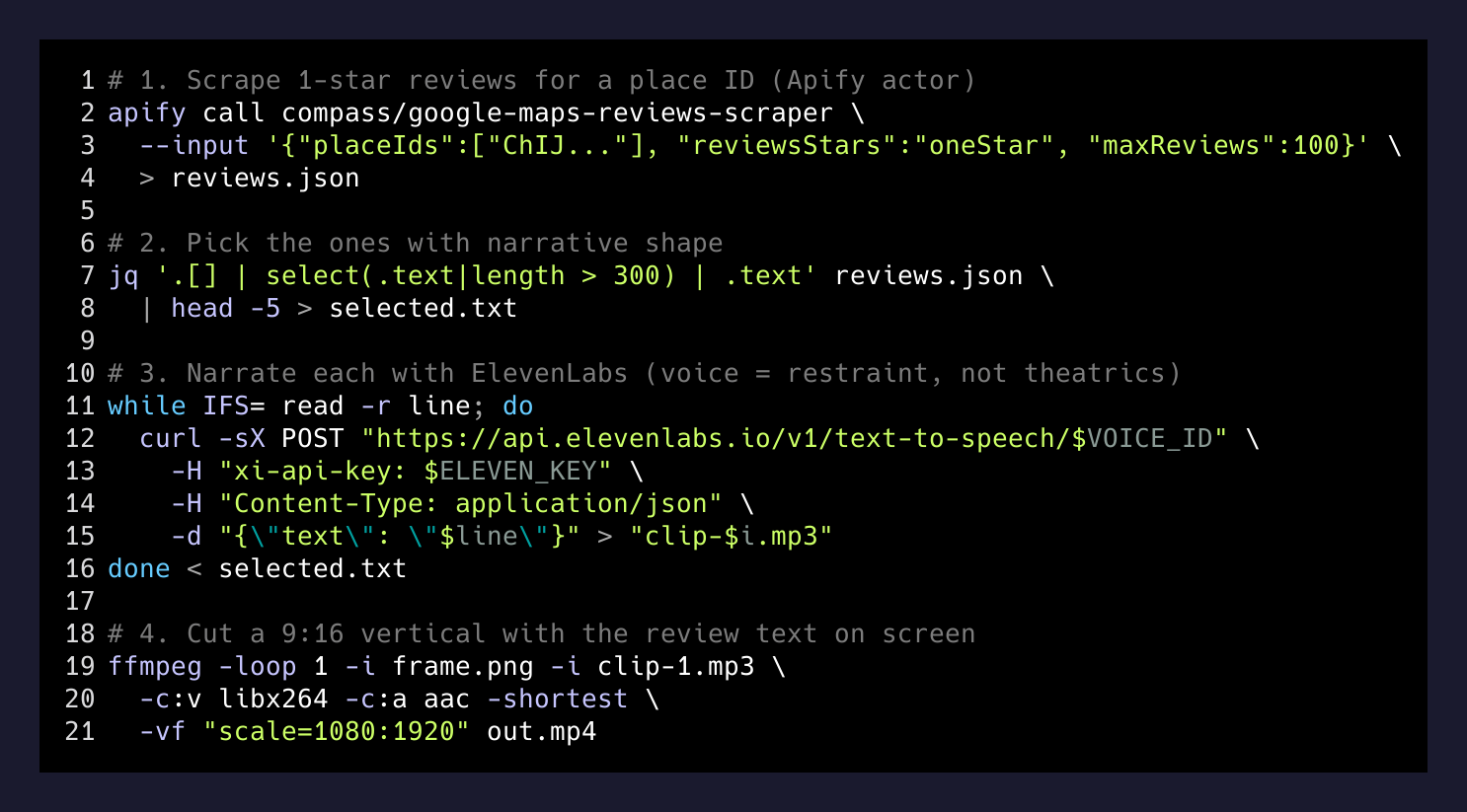
None of these steps are new. The choice that matters is which reviews you feed in.
Which reviews to pick
Not every 1-star is content. A one-line “bad service” from a fake account is a rounding error. A three-paragraph review from a real human who felt genuinely wronged by your bathroom situation is a short story with a beginning, middle, and payoff. You want the ones that read like anecdotes.
Filters I’d apply before feeding anything to the narrator:
- Length over 300 characters, so there is actually a beat structure to read.
- Author has a photo and a review history longer than two entries — filters out obvious fakes.
- No slurs, no threats, no doxxing details. The pipeline picks reviews. A human still edits the list.
- At least six months old — if the customer is still upset today, running their review as a bit is a bad look.
You are not trying to punch down at the reviewer. You are borrowing their words to demonstrate that your business can sit with unflattering feedback and still smile. That is the actual product being sold in the video — composure. The joke is that you were confident enough to press play on it.
Two variants, one pipeline
There are two ways this content works, and they solve different marketing problems.
Own it. A charter operator posts a reel of their own 1-star reviews, narrated deadpan, with a caption that says something like “we have been in business eleven years and thirty-seven people are still mad about it.” This works for hospitality, food, tour operators, anything where personality is part of the sale. Nothing signals “the good reviews are real” like being willing to display the bad ones.
Compare it. The same pipeline pointed at a competitor’s place ID produces the same reel with the opposite framing — “here is what happens when you book with the other guys.” This works in categories where the buyer is choosing between two visible options at booking time, and where the competitor’s actual review corpus is doing the work for you. Less trust-building, more direct-response.
Why nobody has productized this
I looked. As of last week the closest Fiverr sellers in this space are “reputation management” services at $5 to $100 whose entire pitch is removing bad reviews or responding to them. Nobody is offering to make content out of them. The category is empty because the framing is inverted from what everyone was taught about online reviews — treat them as PR damage, minimize the surface area, respond politely, and move on. This treats them as raw material.
The tools have been around long enough that the arbitrage window is real but not permanent. Apify actors, hosted TTS with expressive voices, and a serviceable ffmpeg wrapper. Any two of those existed five years ago. All three together, for under a quarter per finished reel, is a 2026 thing.
Your competition is running polished 15-second promos nobody finishes. You are running a 45-second reel of a stranger, calmly, saying your onions were sad. Guess which one gets watched.
— the honest ad
The takeaway
The interesting content asset most local businesses own is the one they’ve been trained to hide. The pipeline to make something out of it is now cheap, boring, and mostly plumbing. The only thing left is nerve.
If you are one of those businesses, look at your 1-star column tomorrow morning with a different eye. Not “which of these do I need to respond to.” Which of these, read out loud by a calm stranger’s voice, would make you press pause on a scroll.
That review is your best ad. The competition would love it if you kept ignoring it.