
It was 3:30 AM. I was not supposed to be awake, and I was definitely not supposed to be reading the Remotion docs. I’d heard the name for years and filed it under “things React people do that don’t concern me.” I run marketing. I edit reels in Premiere like a normal person.
Then I clicked one link, and an hour later I was sitting up in the dark trying to explain to nobody why I’d been thinking about video wrong for a decade.
The sentence that did it
Here it is, more or less verbatim from the docs:
A video is a function of images over time.
That’s it. That’s the whole reframe. You hand Remotion a frame number. It hands you back a blank React canvas. Whatever you render — JSX, CSS, SVG, a real <video> clip, an audio track — becomes frame N. Render frames 0 through 1799 at 60fps and you have a thirty-second MP4.
I want to be clear about why this melted my brain at 3 AM and not, say, in 2019 when Remotion launched. As a marketer I have never written a <Composition> in my life. I have, however, spent five years thinking about reels as artifacts — finished objects that exist or don’t exist, that took an editor four hours each, that you can’t easily change after the fact. The unit of work was always “a video.”
The minute you accept that a video is a function, the unit of work changes. The unit becomes the template, and the videos are just what falls out when you pass in different data.
A video is a function of images over time.
— Remotion docs, paraphrased
What that actually means in a spreadsheet
I run a couple of ideas in the vault that look like volume plays — “Format Foundry” (reverse-engineer a viral remix account, produce fifty similar clips), “Main Street Reels” (one local-business vertical, ten reusable formats, three reels per business). For years the bottleneck on every one of these has been the same: even with great templates, the act of producing version 11 through 50 is still manual labor in a timeline editor.
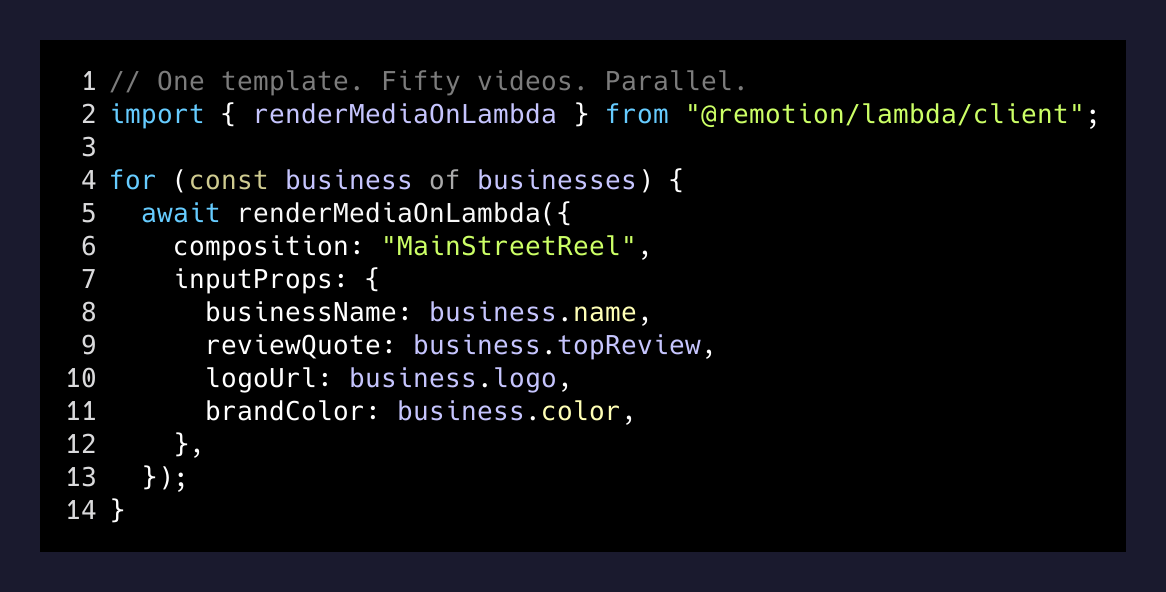
In the Remotion model, that labor doesn’t exist. You write the format once as a React component. You hand it an array of fifty rows from a Google Sheet. You run the renderer. You get fifty MP4s.
// One file. Fifty videos.
import { renderMediaOnLambda } from "@remotion/lambda/client";

for (const business of businesses) {
  await renderMediaOnLambda({
    composition: "MainStreetReel",
    inputProps: {
      businessName: business.name,
      reviewQuote: business.topReview,
      logoUrl: business.logo,
      brandColor: business.color,
    },
    // ... region, function name, etc.
  });
}
That’s not pseudocode. That is roughly the API. The fifty renders happen in parallel on AWS Lambda. The cost per render is fractions of a cent. The thing that used to be a project becomes a script.
I have done batch jobs before. I have rendered things in After Effects with expression sliders. This is not the same. The difference is that the creative artifact itself is now a versionable, diff-able, testable code file. If I want to A/B six hook variations on the same template, I don’t open six projects. I change one string in an array.
The part I didn’t see coming: agents can write the function
The reason I was even on the Remotion site is that someone was talking about Agent Skills on X. The Remotion team shipped a skill pack for Claude Code, Codex, and Cursor — npx skills add remotion-dev/skills — that teaches the agent how to write Remotion compositions from a prompt.
I am a heavy Claude Code user. I have a whole personal-assistant stack built on it. The economics of “I describe the format, the agent writes the React, the renderer mass-produces the videos” hit me harder than the framework itself did. Riley Brown has a video called “Codex Just Replaced 1,000 Hours of Video Editing Tutorials” — 108K views — and his framing is exactly right. The thing that was always too expensive for one person — keeping a Remotion template current with a moving brand and a moving format — just got handed to an agent.
What changed in my head
For five years I’ve sorted video ideas into “could I produce this?” and “is this just too much work?” Most of the interesting ones lived in the second bucket. The marginal cost of reel #11 was identical to the marginal cost of reel #1, so most concepts capped out at “make three and post them on Tuesday.”
Remotion doesn’t reduce that marginal cost. It deletes it. The template took the work. The instances are free.
- Pre-3 AMVideo as artifactEvery reel is a project. Versions cost as much as originals. Most volume ideas die in the queue.
- 3:30 AMVideo as functionThe template is the work. Instances are array elements. Volume ideas become for-loops.
- AfterAgent as the template writerPrompt the format. Claude writes the composition. The renderer makes the videos.
I’m not announcing a build. I haven’t shipped a single Remotion render. What I’m announcing is that a category of idea I’d been quietly discounting for years is back on the table, and that the 3 AM moment was worth being awake for.
The takeaway, for anyone else who edits in a timeline
If your job has ever included the phrase “we’d love to do that at scale but it’d be ten hours of After Effects per version” — go read the Remotion landing page once. Not the tutorial. Just the sentence about images over time.
If it lands the way it landed for me, you’ll know within ninety seconds. The reframe is the product. The rest is just typing.