 Marketing & SEO
I rank on page one of Google for “comal vs guadalupe river tubing” and I don’t own a single inner tube. I don’t run a shuttle. I don’t have a permit, a parking lot, or a kid in a life vest. The site is austinriverfloat.com. I built it because I want to sell marketing services to Central Texas tubing operators and I got tired of pitching with words.
Last 28 days, before tubing season has even fully ramped up:
0
clicks
0
impressions
0
indexed pages
0
avg position
Sixty-eight clicks is not a business. It is a demo. And a demo is exactly what I wanted.
The pitch problem
You can walk into a tubing operator in New Braunfels in June and say “I do SEO and content marketing.” They have heard that sentence ten times this year, usually from someone whose other client is a dentist. The next sentence out of your mouth has to do work the first one didn’t.
The next sentence I want to say is: “Your future customers are searching austin river tubing and comal vs guadalupe river tubing and is the austin river safe to tube right now — here’s a Search Console screenshot of all of it. I rank for those queries. I will move that traffic into your funnel.”
That sentence requires a site. Not a case study from a former client. Not a slide deck. A live URL with live data.
So I built one.
The build
Next.js 15, Tailwind 4, Vercel, auto-deploys from main. Twenty content URLs in the sitemap. Schema markup on every page. An llms.txt because the AI crawlers are now a real referral source and ignoring them is the same mistake as ignoring Google in 2002.
src/app/blog/
├── 4th-of-july-river-tubing-austin-2026
├── austin-river-comparison-guide        ← #1 page, 1726 imp / 39 clicks
├── austin-river-tubing-2026-season-opening-guide
├── bachelorette-party-river-tubing-austin
├── bachelor-party-river-tubing-austin
├── best-austin-river-tubing-companies
├── best-time-austin-river-tubing-seasonal-guide
├── comal-river-family-tubing-guide
├── is-the-austin-river-safe-to-tube-right-now
├── memorial-day-weekend-river-tubing-austin-2026
├── river-tubing-with-kids-austin-family-guide
├── rockin-r-river-rides-guadalupe-guide
├── texas-tubes-san-marcos-complete-guide
└── what-to-bring-river-tubing-texas-checklist
The content map is deliberately commercial. Every URL is something a person searches in the week before they spend $40 to $200 per person on a float trip — comparisons, safety, what to bring, which operator, which weekend, which river. The traffic is qualified by definition. The page that wins is the river comparison guide, because nobody who lives in Texas knows the difference between the Comal and the Guadalupe before they have to.
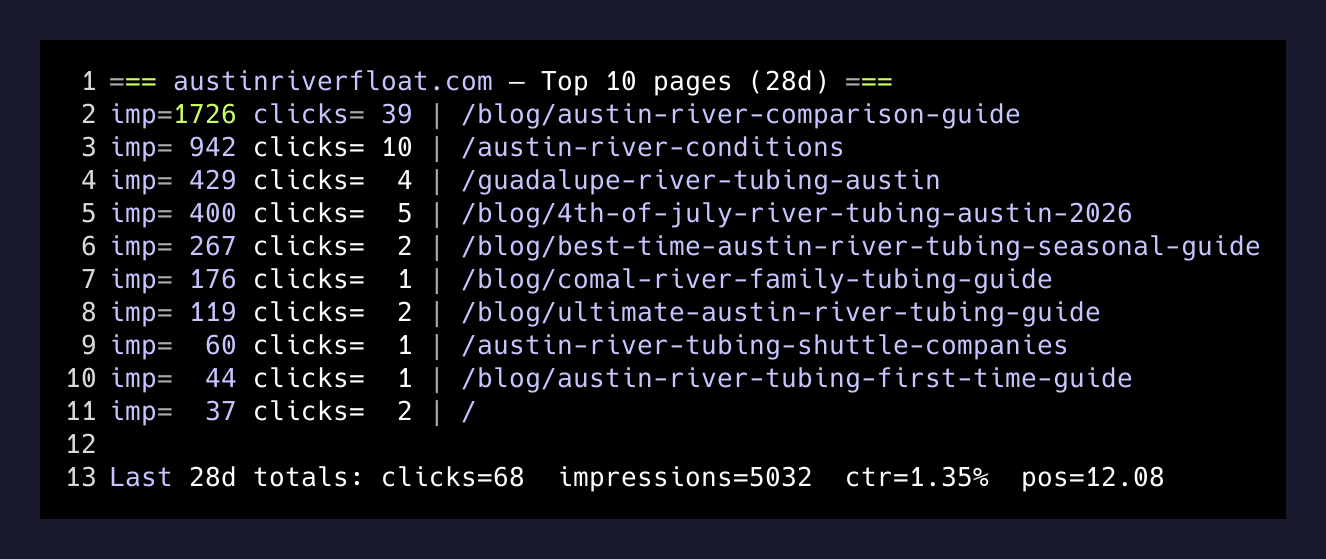
The 28-day picture
The top page does most of the work. 1,726 impressions, 39 clicks, sitting at an average position around 5. The live river conditions page is doing 942 impressions, 10 clicks. The 4th of July post is climbing into the seasonal swell — 400 impressions, 5 clicks, and the holiday is still four weeks out.
The top query is exactly the one I built the site around: comal vs guadalupe river tubing. The intent could not be more obvious. They are deciding between two rivers. After they decide, they search for an operator. The operator I refer them to is whoever pays me.
That’s the play.
The deliverable is the pitch. Build the asset before the conversation, not after.
— Brett Ridenour
Why a portfolio site beats a case study
Case studies have three problems when you’re selling to a small operator:
- They are someone else’s results. The skeptical operator wants to know if you can do it for them.
- They are usually old. The screenshot is from 2023, the algorithm has eaten itself twice since then.
- They require trust before they create it. You have to convince someone you didn’t fake the numbers.
A live SEO site solves all three. The numbers are live. The data is in their niche. They can search the query themselves, see me on page one, and click through to a site they could have built. The whole sales cycle compresses into: “I did this for nobody. Imagine what I do for you.”
The other thing I like is that it keeps me honest. The site has to actually work. I have to maintain it. I have to update the live conditions block weekly during season. The pitch is gated by the doing.
The non-obvious cost
Building an SEO site for a niche you have no stake in feels free until you remember that you have to update it. Float Fest got canceled — I had to scrub the site. Operator pricing shifted on three pages — I had to verify each one against a real website before pushing. The Memorial Day post had a stale CFS reading two weeks after I shipped it.
The cost isn’t the build. It’s the rot. Content sites decay fast in 2026, and the AI summary boxes punish anything that smells stale. Weekly in-season touch-ups are the difference between a portfolio site that helps me close deals and a portfolio site that makes me look careless.
I plan for that the same way I plan a deploy: it’s on the calendar, weekly, May through August.
The lesson, if there is one
If you sell something abstract — marketing, design, engineering, AI consulting — the highest-leverage thing you can do for your sales pitch is to build the thing you’d build for a client, but for yourself. Not a case study. Not a portfolio of past work. A live, current, indexed, growing asset in the niche you want to sell into.
It is more expensive than a Notion page. It is more honest than a slide deck. And on the day you walk into the room, you have something nobody else does: proof.
Sixty-eight clicks. Five thousand impressions. Twenty-two indexed pages. A niche I don’t even own.
The pitch writes itself.