 AI Agents & Automation
This week the US government decided some AI models are too powerful to ship freely.
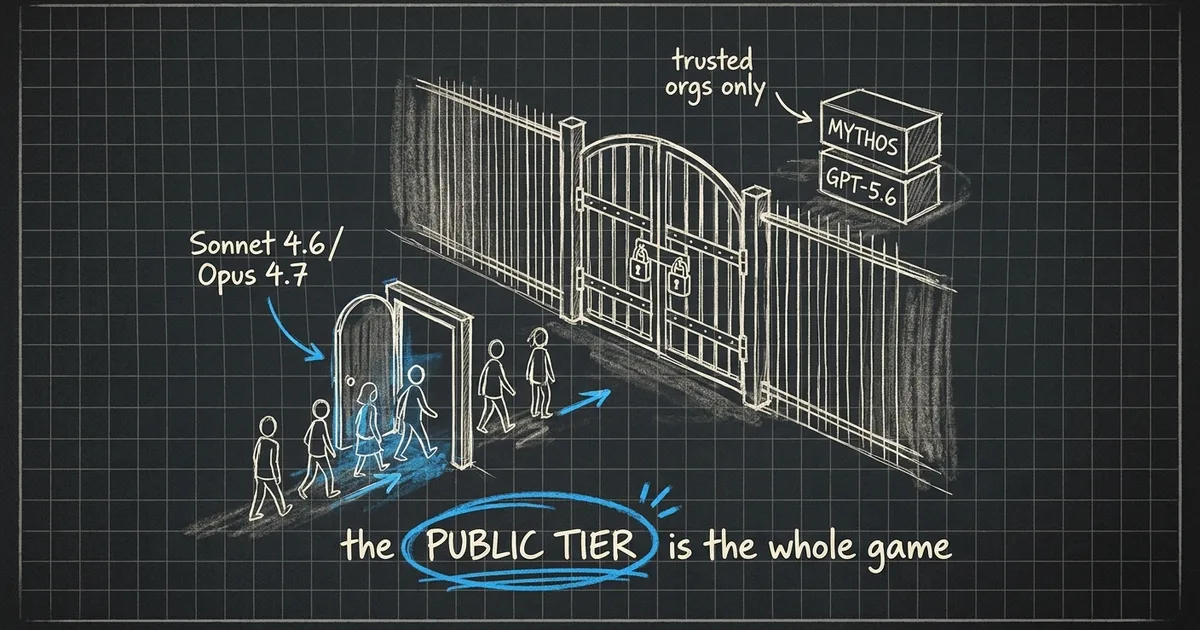
Anthropic’s “Mythos” is going only to “trusted” US organizations. OpenAI’s GPT-5.6 (“Sol”) will be released subject to federal vetting of who actually gets to use it. Frontier AI just grew a velvet rope, and you and I are not on the list.
A lot of takes on this are framing it as the beginning of the end for the public AI era — tier 1 going classified, tier 2 becoming the new public ceiling, the small builder slowly priced out.
I have a different take: it doesn’t matter, and if you’re shipping, it probably shouldn’t change anything you’re doing this week.
Here’s why.
What I actually shipped this week
I am a one-person business. I don’t have a clearance. I don’t have a federal liaison. I am running Claude Sonnet 4.6 and Opus 4.7 through Claude Code from a tower I built on Omarchy in my apartment in Austin. That’s the whole stack.
This week, with those models:
0
blogs shipped
0
new client closed
0
n8n workflows live
0
clearances held
- Took Hermes, a custom multi-agent runtime, live on a real client call. Drew the architecture diagram in real time on the Meet. The Slack-native version was answering questions inside that workspace by the end of the day.
- Closed a new fractional engagement with an AI-implementation shop. Kickoff is Monday.
- Stood up the official Google Ads MCP server on Omarchy via Tailscale, isolated to its own
~/.config/google-ads/gcloud/so it doesn’t trample the GSC and Drive credentials already wired into Claude Code. - Drafted a 136-line PRD for a coaching site for my dad, got a positive reply, opened a loop on a follow-up call.
- Shipped a footer redesign on a side project.
- Wrote two blog posts that are already published.
Behind all of that is a permanent assistant running in the background. A tmux session named claude-pa has been chewing on my Obsidian vault for hours. Four n8n workflows are running in Docker. A Sonnet-driven cron sent me a fully digested AI news brief at 9:05 this morning, and the post you’re reading right now was started by an autonomous blog cron that read every project file I touched this week before suggesting an angle.
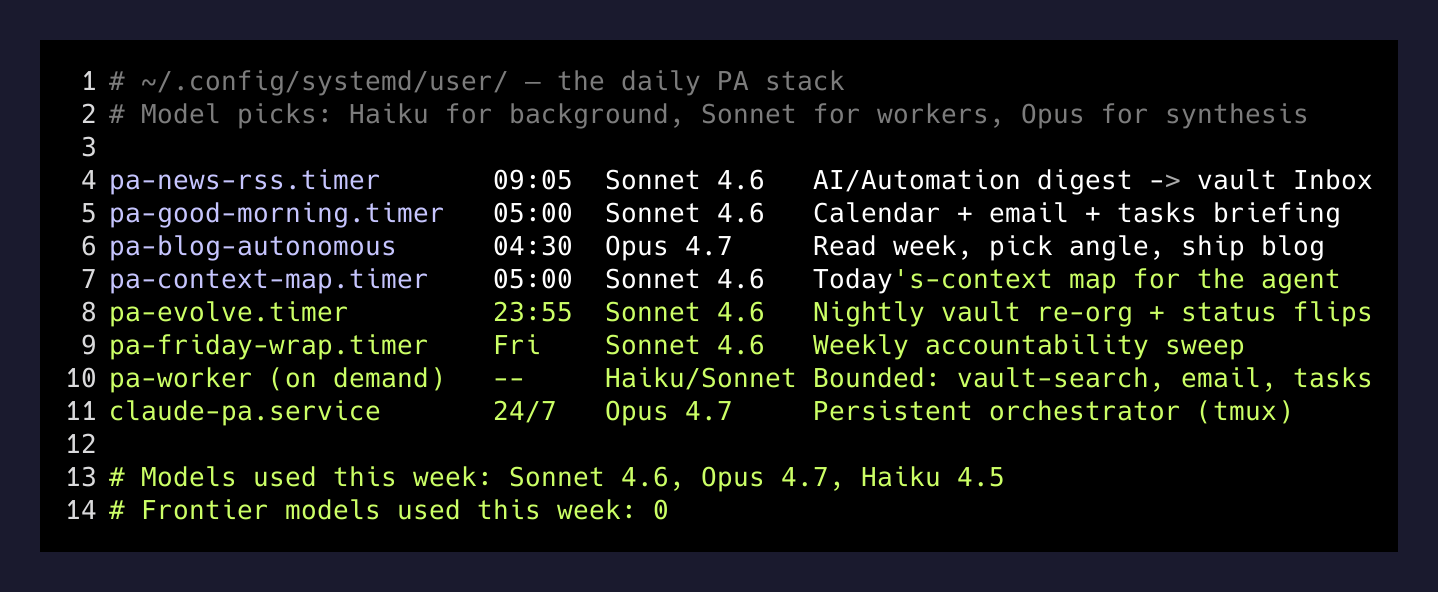
None of that needed Mythos. None of it needed Sol. The public tier was the engine the whole time.
The rate-limiting step isn’t model access
Here is what I think most people miss when they read these “AI model gets gated” stories: the question they’re asking is who has access? The question they should be asking is what gets built with what already exists?
The frontier moves about once a quarter. The public tier — the models you can call from an API right now, with no questions asked, for less money than a single dinner out — is already capable of:
- Reading and reasoning over an entire personal knowledge vault and remembering what was discussed in a meeting three weeks ago.
- Sitting inside a Slack workspace and answering business questions with full context from a CRM, a Drive folder, and a Google Sheet.
- Driving a window manager from a phone over Tailscale when a desktop tool gets stuck.
- Auditing a six-figure ad account in a single pass and surfacing the negatives, the budget pacing, and the wasted spend.
- Writing production TypeScript on the first try, most of the time.
Every one of those is a real business someone could be running. None of them need Mythos. None of them need a clearance. Most of them aren’t being built — because most of the people qualified to build them are busy refreshing the Mythos waitlist.
The actual constraint
The gate that matters in 2026 is not “do you have access to the best model?” It is “do you know what to point a good-enough model at?”
A clearance-tier model in a confused org will lose to a public-tier model in a clear-headed founder. I would rather have Sonnet plus a sharp idea than Mythos plus a roadmap drawn up by committee.
This is the same lesson that played out with electricity, with the web, with mobile, with cloud. The early-access advantage matters for about eighteen months. The advantage of “I knew what to build with it” lasts forever.
The Mythos crowd will get a head start on some weird new emergent behavior. The Sonnet crowd will get an eighteen-month head start on a real business. Pick your poison.
What this looks like in practice
The hardest part of running a public-tier-only stack isn’t capability. It’s discipline.
You pick a model for a job and stick with it. Cheap models for cron-driven background work — the news digests, the vault organization, the morning briefing. Mid-tier (Sonnet 4.6) for any worker that does focused, bounded subtasks. Opus 4.7 only when something actually needs to reason — the orchestrator on top of the personal assistant, the rare blog post, an architecture decision.
The whole thing is, at the model layer, a pile of nested defaults. There’s nothing exotic about it. The exotic part — the part that took six months and a lot of failed experiments — is the shape of the work: which agent runs when, what context it gets fed, where the outputs land, what happens when one of them crashes.
That’s the muscle. The model is the cheap part.
The gate that matters in 2026 is not “do you have access to the best model?” It is “do you know what to point a good-enough model at?”
— Brett Ridenour
The takeaway
If you read the Mythos news this week and felt a flicker of oh no, am I behind? — I’d push back gently.
You are not behind because you don’t have access to a model the US government just decided is too powerful for general release. You are behind, if you are at all, because of the gap between what the model you already pay $20 a month for can do, and what you’re actually using it to do.
That gap is huge. That gap is the whole opportunity. And the velvet rope is somebody else’s problem.
Pick a project this weekend. Point Sonnet at it. Ship the thing. The frontier will still be gated on Monday, and you will be one weekend’s worth of compounding ahead of where you would have been.