
A small site I help with sat for weeks with “perfect” SEO. Title tags written. Meta descriptions tuned. Article schema injected via two merged PRs. I ran it through every scanner on the internet and they all gave it a thumbs up.
Then I searched for the domain name on Google.
Nothing. Not the homepage. Not the subdomain. Not even the exact-match URL in quotes. Google wasn’t ranking it low. Google didn’t know it existed.
This is the gap no one warns you about. On-page SEO is the layer everyone fights over because it’s the layer you can measure. Indexation is the layer that decides whether any of it matters, and most SEO guides whisper past it like it’s a formality. It isn’t.
The three gates before you ever rank
Before Google can decide you’re the third result for a query, it has to clear three separate gates, in order. If any one fails, the next doesn’t run.
Three gates. Ranking is gate 4.
The best title tag in the world doesn’t open gate 1. Gate 1 opens when Google either stumbles into a link pointing at you, or when you walk up to the front door of Search Console and hand them a sitemap.
If you’re a brand new domain with zero backlinks, there is no stumbling. You have to knock.
What I found when I actually looked
I ran through the gates one at a time. Here’s the real checklist I use now, in order:
Gate 1 — Is the property verified in Search Console? Not “do I have a Google account.” A verified GSC property, either URL-prefix or Domain. If no, nothing else matters. Add it, verify by DNS TXT record for the Domain property, done.
Gate 2 — Is there a sitemap, and has it been submitted? Having /sitemap.xml live on the site is not the same as submitting it. Submitted sitemaps go into a different pipe — Google parses them aggressively, surfaces URLs faster, and reports per-URL indexing status back to you. Most frameworks (Astro, Next, Hugo) generate one automatically, but if you never paste it into GSC’s Sitemaps panel, Google treats it as a maybe.
Gate 3 — Does robots.txt accidentally block something it shouldn’t? The one I see most: a staging config that disallows * ships to prod and nobody re-reads it. Open the file, read every line out loud. If it says Disallow: / with no Allow: reversal, your site is gone from the index until you fix it.
Gate 4 — Does the page return 200, with a <title> and real <body> content, on a plain curl? Not in a browser. In a curl. If your content is rendered by JavaScript and the raw HTML is a skeleton, Googlebot can render JS, but it does it in a second pass, days later, and it drops pages that look empty on first fetch. SSR or pre-render anything you want indexed.
Gate 5 — Are there any backlinks pointing at the domain, from anywhere? Zero backlinks + brand new domain = you are a stranger. Google is not going to crawl a stranger aggressively. One link from a page it already crawls — a personal site, a GitHub README, a Reddit comment that doesn’t get removed — can shift you from “ignored” to “crawled daily.” Not a growth hack. A doorbell.
Gate 6 — Request indexing for your five most important URLs manually. URL Inspection → Request Indexing. It’s rate-limited and not a guarantee, but for a new site it’s often the thing that pushes you over the line.
The thing the guides don’t say
Every “SEO checklist” article I’ve ever read is really a checklist of gate 4 and gate 7 (ranking) problems. Alt tags, heading hierarchy, keyword density, internal link anchors, meta description length. All real, all optimizations within a page Google already crawls.
None of them tell you to go check your sitemap submission status in GSC. None of them say the words “a brand new domain with no backlinks is invisible by default.” They assume Google already knows you exist, which for your side-project launched last Tuesday is a very bold assumption.
On-page SEO is what you do once Google is paying attention. Indexation is how you get it to pay attention in the first place.
— Lesson from a weekend of debugging
The CLI I now reach for first
Having gsc as a shell command — I wrote about wiring Search Console into Claude Code a few months back — makes this diagnosis take ninety seconds instead of an afternoon. The flow I run now, in order, when any new site goes live:
# 1. Is the property even registered?
gsc sites | grep mydomain

# 2. Which URLs does Google think it has, and what state are they in?
gsc index mydomain.com

# 3. Last 28 days of impressions — is it zero, or just low?
gsc report mydomain.com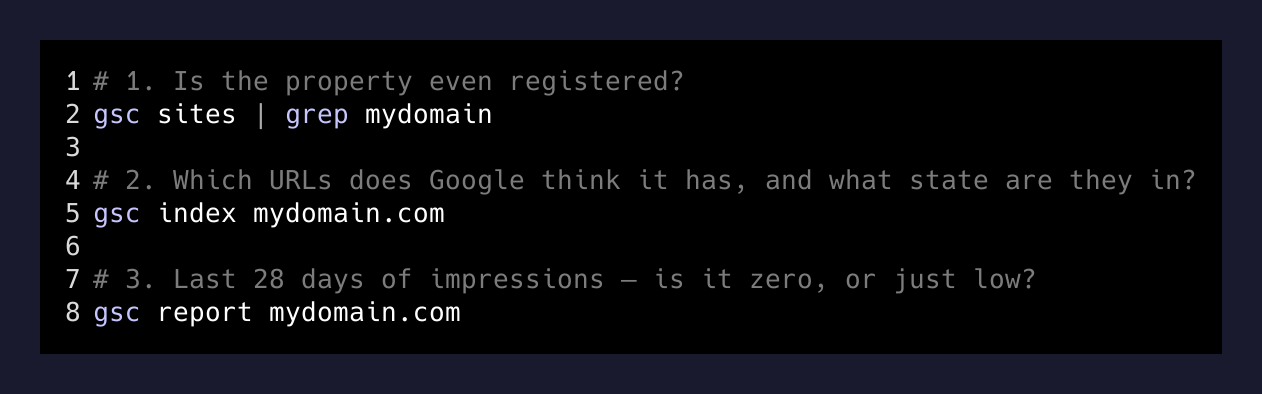
Zero impressions over 28 days on a verified property with a submitted sitemap means Google is choosing not to index you. That’s a content or trust problem — thin pages, duplicate content, no E-E-A-T signals. Non-zero impressions and no clicks means you are indexed, just not ranking. Totally different problem, totally different fix.
The CLI collapses “is this an indexation problem or a ranking problem” from a vague feeling into a one-line answer. Which is the only thing that matters, because the fix for each is completely different.
Takeaway
If you launched something recently and it isn’t showing up in Google, stop tweaking title tags. Open Search Console. Walk the gates in order. Nine times out of ten the fix is one of three things:
- You never submitted a sitemap.
- Your
robots.txtis lying about what you want crawled. - You have zero backlinks and zero sitemap entries, and Google has no idea you exist.
The uncomfortable truth is that for a new domain, SEO work before indexation is sanding the deck of a boat that’s still in the garage. Get it in the water first.