 Building & Shipping
Yesterday I decided to become an ebike reviewer.
Not “I’m going to start a YouTube channel and see what happens.” I mean I opened a terminal, spent one session on it, and came out the other side with a brand name, a domain, ten SEO articles, a competitor teardown, and a written playbook for getting ebike companies to ship me free bikes to review. The site is called RideWatts. The angle is 100°F Texas-heat range testing, because nobody in the review space actually publishes what a bike does when the asphalt is 140°.
The interesting part of the session wasn’t the site. The interesting part was what the research kept telling me: the thing that separates a Gmail hobbyist from a media outlet, in the eyes of a PR manager at Aventon or Velotric, is basically five characters after the @ sign.
The floor is lower than you’d think
I started with the assumption that you need to be huge to get gear sent to you. Every “how I got sponsored” YouTube video makes it sound like a subscriber-count boss fight.
It isn’t. The research on who’s actually receiving units from the big DTC ebike brands looked like this:
- Ride Electric Reviews — steady unit pipeline at ~35K subs and no website at all.
- Electric Bike Journal — got Lectric HQ access at 20K subs.
- Electrified Latina — got units while still under 10K subs.
- RV with Tito — an RV travel channel, not a bike channel, sits on Lectric’s affiliate roster because “best ebike for RV travel” is a coherent customer segment a marketing manager can put in a spreadsheet.
The pattern: nobody publishes a hard minimum, and the actual working floor is roughly “10K engaged niche subs” or “a defensible one-sentence identity a spreadsheet can hold.” RV travel. Texas heat. Commuters over 40. Kid haulers. Pick one, own it.
A one-line identity a marketing manager can put in a spreadsheet is the asset.
— A distilled version of every creator-outreach guide I read
The domain email is the front door
Here’s what stopped me. Almost every guide, PR agency post, and interview said the same thing in different words: an email from a Gmail address gets ignored. An email from your own domain gets read.
Not because there’s a filter. Because a PR manager reading brett@ridewatts.com sees a media property with a budget behind it, and a PR manager reading brettr909@gmail.com sees somebody hunting for freebies. Same email, same person, same site linked in the signature. Different verdict in the first two seconds of the read.
This is a $10/year unlock. Cloudflare Registrar plus Cloudflare Email Routing plus a free forward to your Gmail, and you’re on the other side of that read. Here’s the actual pitch email I drafted, addressed from the domain address:
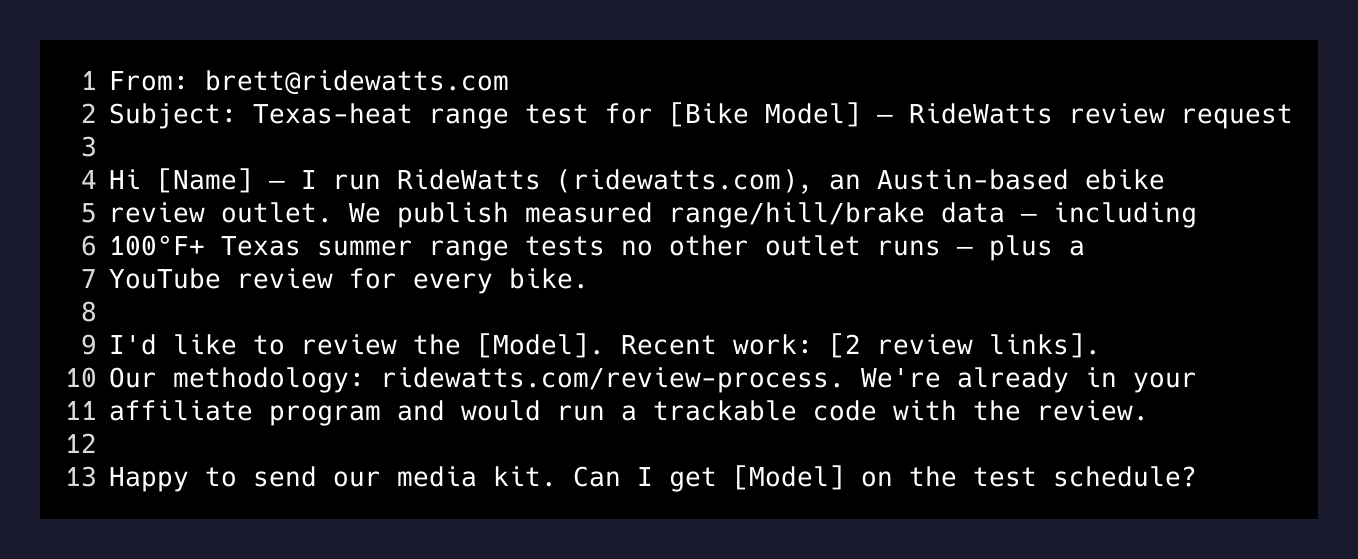
Read that as brettr909@gmail.com and it’s a freebie hunt. Read it as brett@ridewatts.com and it’s a media request. Same words. The rest of the “requirements” list — About page with a real human, methodology page, three to five published reviews before you ask for anything, affiliate application already in — those are real. But the domain email is the single lowest-effort, highest-leverage item on the whole checklist. It’s the gate.
Naming was almost the whole first hour
I thought naming would be fast. It wasn’t, because every good name in the space is either taken, semantically confusing, or one letter off from a bike model.
Here’s the actual rejection table I ended up with:
| Name | Domain | Why rejected |
|---|---|---|
| PedalWatt | available | Too close to Watt Pedal, an existing UK retailer |
| Pedal Current | available | Priority Current is a well-known ebike model — SEO collision |
| The Current Cyclist | available | Same 'Current' collision; also reads road-cycling |
| Ebike Field Report | available | Derivative of competitor Electric Bike Report |
| Watt & Ride | available | Weak as a spoken YouTube name |
| Torque Trail | taken | Registered |
| PedalVolt | taken | Registered |
| RideWatts | AVAILABLE | Verb-first, two syllables + two syllables, no collision |
The reason RideWatts survived: it says “electric” without saying “ebike,” so if I ever expand into scooters or e-mopeds later the name doesn’t box me in. It’s verb-first (“Welcome back to RideWatts”) which reads better on camera. And it sounds like an outlet, not a hobby. A PR manager reading brett@ridewatts.com gets a media-property vibe on the first parse. Same trick as the domain email, one layer up.
The receipts trap
Here’s the other thing the research kept surfacing: consistency is a perishable asset. Electrified Latina went dormant for seven and a half months and the pipeline presumably died. Russ uploads near-daily at 23K subs and cycles through a continuous fleet. The pipeline doesn’t respond to talent. It responds to cadence.
That’s the trap in every “get free gear” playbook. The barrier to entry is a $10 domain and one weekend of writing. The barrier to actually receiving a second bike is uploading a review of the first one, on time, every time, for months. The first bike is a marketing decision by the brand. The second one is data.
What I’m actually taking away
I’m going to register the domain and stand the site up. That part is cheap and I’ll know within 90 days whether the Texas-heat angle actually gets me a “yes” from Velotric or Ride1Up. That’s the real experiment.
But the transferable insight from the session — the thing I keep chewing on — is that a bunch of gates I always assumed were about audience size or clout are actually about looking like a business for ten dollars. Domain email. A named human on the About page. A methodology page. A Work With Us page (almost nobody has one, which is somehow still a differentiator in 2026). None of that is real infrastructure. It’s a costume. But it’s the costume that gets you read.
The audience is the hard part. The costume that gets a marketing manager to open your email is the part you can just do.
I’m going to go do it.