
I have a lot of things in flight. Twenty-nine projects in the vault. Seventy-seven Fiverr gig concepts. A directory of “ideas” that I keep promising myself I’ll thin out.
The standard advice is to focus. I know. The harder question is: focus on what? Every project has a story about why it’s the one. Every Fiverr gig has a “this could be the entry wedge” justification. The narratives compete and the calendar fills up and at some point you realize you’ve been doing motion, not progress.
So this morning I tried a different lens. I opened Claude Code in the vault and asked one specific, slightly absurd question:
If I had $100k to spend on media buying tomorrow, which of my projects, ideas, or Fiverr gigs could absorb it the fastest?
The point wasn’t that I have $100k. The point was that “$100k of paid media” is a brutal filter. It forces you to score everything on the same axis. A project either has a click-to-revenue path that survives contact with a cold CAC, or it doesn’t. The narrative doesn’t get a vote.
The rubric Claude built
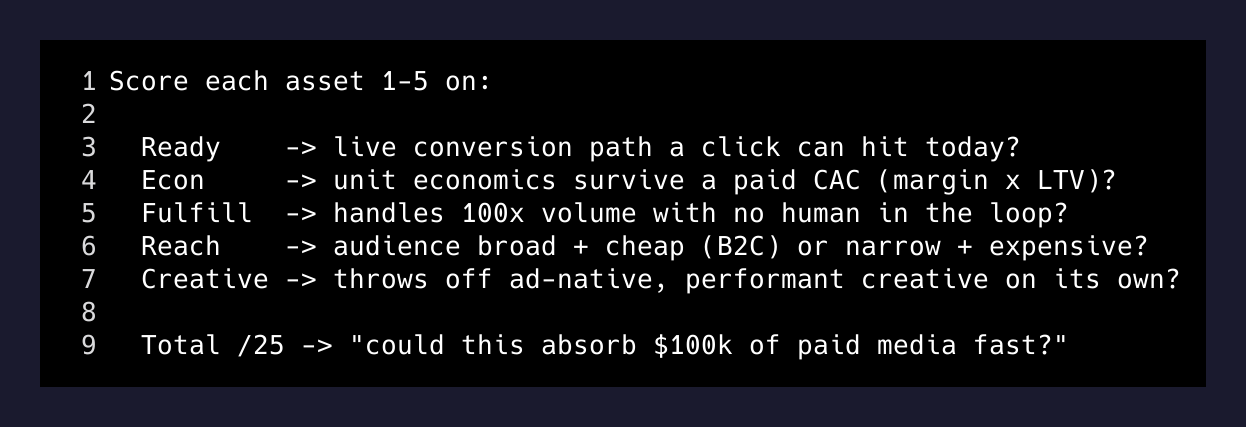
I didn’t hand it a rubric. I wanted to see what it would invent. It came back with five dimensions, scored 1–5:
- Ready — is there a live conversion path a click can hit today?
- Econ — do unit economics survive a paid CAC (margin × LTV)?
- Fulfill — can it handle 100x volume with no human in the loop?
- Reach — is the audience broad and cheap, or narrow and expensive?
- Creative — does the product throw off ad-native, performant creative on its own?
That’s a tight rubric. The “Fulfill” dimension is the one I would have skipped, and it’s the one that ended up doing the most work. Most of my “businesses” are actually me — the bottleneck is human capacity, not demand. Pour $100k of leads into a service offering and you don’t get a bigger business, you get a backlog and a sleep deficit.
Half my portfolio failed before the scoring started
Before any ranking, Claude split everything into three buckets:
- Things that could plausibly be media-buyable. Apps, consumer sites, productized digital offers.
- Client and retainer work. These scale with headcount, not ad spend. Media-dead.
- Internal tooling. My personal assistant system, automation stack, internal dashboards, and planning tools. Real time invested. Nothing to sell. Not products.
That second bucket stung a little. A lot of what I think of as “my business” lives there. It pays the bills. It just doesn’t scale with paid acquisition, because every new client is another mouth to feed with my own hours.
The third bucket stung more honestly. I have spent real weeks building tools for myself. Some of them are good. None of them are products until I decide they are.
Pouring media into a service offering manufactures a backlog, not a business.
— The rubric, applied to my own portfolio
The verdict
After Claude scored everything that survived the first cut, the ranking surprised me.
| Asset | Score /25 | The catch |
|---|---|---|
| A consumer mobile app I've been prototyping | 18 | Not monetized yet. Scoring high on potential, a 1 on Ready. |
| A niche operations platform I run | 17 | Real revenue plumbing. Tiny niche — physically can't absorb $100k of clicks fast. |
| A high-traffic content site I run | 17 | Live, scales infinitely. No transaction layer. A firehose with no tap. |
| A content/creator brand | 17 | Broadest cheap audience. Monetization is indirect (sponsors, courses). |
| A productized digital download | 17 | Automated fulfillment, makes its own demo. A $9 single item can't cover a paid CAC — a $29–$99 bundle can. |
| A high-margin managed service I offer | 13 | High ticket, real economics. But I am the fulfillment. $100k of leads = me drowning. |
The top scorer was the consumer mobile app I’ve been prototyping — not because it’s my best business, but because consumer mobile is the only asset class in my portfolio that paid media is purpose-built to scale. App-install UA is the most liquid ad market on earth. Clean install→activate→subscribe funnel. Infinite fulfillment. The product is the ad creative.
And yet it scored a 1 on Ready. You cannot responsibly point $100k at an unlaunched, unmonetized prototype. You’d buy vanity installs and torch most of it.
So the honest answer wasn’t “deploy $100k.” The honest answer was sequenced:
- First $8–10k: ship a monetized build, basic ASO, instrument the funnel. Run small UA. Find a CAC and a D7 retention number.
- If CAC < LTV, deploy the rest. The score’s other 5s do the work.
- If the math doesn’t clear, don’t. Redirect.
That’s a real plan. It cost me about three minutes of agent time to get there.
The sleeper in the table was the productized digital download. It tied for second, and unlike the app it’s ready — automated fulfillment, no human in the loop, creative that demos itself. The version of it that actually clears a paid CAC is a bundle, not a single file: package together open-source, MIT-licensed plugins into one polished, documented kit, sell it on Gumroad, and acquire with paid ads at a low CPA. A $9 single item can’t survive cold acquisition. A $29–$99 bundle can — high enough to cover the click, low enough to be an impulse buy. It’s the one asset where “deploy media tomorrow” isn’t a fantasy.
The uncomfortable lesson
Here’s the part I didn’t expect.
The asset I am most emotionally invested in — the managed service business with real margin and live clients — scored a 13. Not because it’s a bad business. It’s a great business. But it’s a great business that scales with hiring, not with ad spend. Pouring media at it would manufacture a backlog and a hiring problem I’m not equipped to solve this quarter.
Meanwhile the asset that scored highest is the one I keep treating like a side project, because it isn’t earning anything yet. The scoring inverted my emotional ranking almost perfectly.
This is the use I keep finding for these models that nobody talks about enough. Not “write me code.” Not “draft me an email.” Specifically: give me a rubric I would not have built for myself, then apply it to my own portfolio honestly enough that I can’t argue with it. I am very good at arguing with myself. I am much worse at arguing with a clean table.
The portfolio doesn’t change because of one conversation. But the next time I sit down to decide what to spend a Saturday on, I’ll have those five columns in my head. Ready. Econ. Fulfill. Reach. Creative. And a quiet little voice asking whether the project I’m about to open would survive a cold click.
That, more than the ranking itself, is what the imaginary $100k bought me.