
I keep a per-day digest of every Claude Code session I open. Project, message count, which worktree. Not because I love metrics — because after a year of building with agents I kept losing track of how much I was actually doing. Some weeks felt heavy and were empty. Some weeks felt quiet and had six features in them.
Last weekend’s row is the first one that looked like a shape instead of a pile.
The row
2026-11-01 (Sun) — 41 msgs, 19 sessions
2026-11-02 (Mon) — 81 msgs,  7 sessions
2026-11-03 (Tue) — 12 msgs,  5 sessions
2026-11-04 (Wed) —  3 msgs,  2 sessions
2026-11-05 (Thu) —  0 msgs
2026-11-06 (Fri) —  0 msgs
Nineteen sessions on Sunday across eighteen different worktrees. Seven sessions on Monday across four. Nothing Thursday or Friday. The messages-per-session ratio is the real tell: Sunday was 2.2 messages each, Monday was 11.6. Sunday I opened things. Monday I finished four of them.
What the worktree names were doing
I run Freebo — a booking platform for tour operators — out of a single monorepo with a lot of parallel git worktrees. When I’m about to start a sprint I fan out branches by feature, one worktree per idea, and point a fresh agent at each one. The names on Sunday were things like tips, ads-tracking, insights, crew, holds, booking-requests, api-keys, custom-checkouts, mcp, sync. Each one a different “could this work” sitting in its own directory with its own node_modules and its own Playwright run.
That is not a plan. That is a pile of experiments.
The agents were not writing the whole feature on Sunday. They were doing the thing I find hardest to start: putting a spike in the ground. A plan doc. A migration file. A failing test. The smallest possible version of the thing I’d been describing in my head for a week. The Sunday ratio — two messages per session — was mostly me opening a worktree, pasting a one-paragraph brief, reading the spike, and closing the tab.
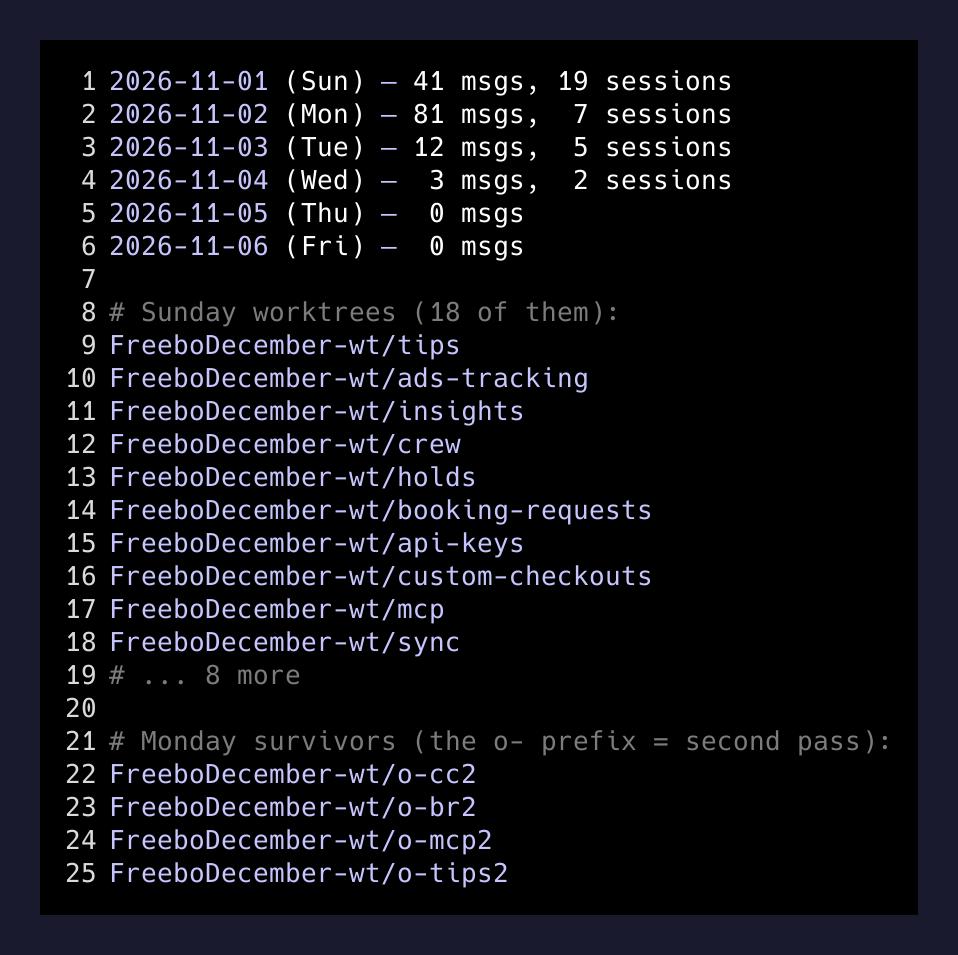
Eighteen worktrees turned into four survivors overnight. Monday’s digest shows them: o-cc2, o-br2, o-mcp2, o-tips2. The o- prefix is a second pass — a new worktree I cut off main to actually build the one I’d decided mattered. The other fifteen got archived without a commit ever landing. That’s the part nobody tells you about agent-heavy work. The expensive step isn’t writing code. It’s writing the wrong code because you didn’t let yourself try three versions.
The Monday shape
Monday was 81 messages across 7 sessions. Those four o-* worktrees did most of the volume: custom checkouts, booking requests, an MCP server, operator tipping. The other three sessions were small — triage on main, a config fix, a release note. The ratio flipped because I wasn’t opening anything. I was in four conversations that each had state, and I was closing them.
The expensive step isn’t writing code. It’s writing the wrong code because you didn’t let yourself try three versions.
— Me, every Monday morning, surprised
I also stopped using worktrees on Monday the way I used them on Sunday. Sunday they were cheap ideation. Monday they were stateful conversations I didn’t want to pollute with unrelated questions. “Don’t ask the booking-requests agent about tipping” is a rule the directory structure enforces for me.
The part that surprised me
I thought the interesting number would be the fan-out. It’s the zero days.
Thursday and Friday have no entries. Not a few sessions, not one — zero. I didn’t plan it. I opened my laptop both mornings, looked at what was in front of me, and genuinely did not want to add any more code to Freebo. Not because I was burned out. Because I was still metabolizing Sunday and Monday. Four features in four directories is more surface area than my head holds, and the only way to keep holding them is to stop adding more.
- SunFan out19 sessions, 18 worktrees, one spike each. Mostly cheap opens.
- MonCull and close4 survivors. 81 messages across those 4 + light main triage.
- TueTaper12 messages. Review PRs, land what was ready.
- WedAdmin tail3 messages. Light project. One tool audit.
- Thu–FriNothingNo sessions. Not a scheduled break. Just no appetite to open anything.
This used to make me anxious. I would open the laptop on Thursday and feel like I was slacking because my fingers weren’t moving. I now think the two quiet days are load-bearing. If I’d pushed through them with a fifth and sixth worktree, Monday’s four features would’ve gotten shallower code review and worse Playwright coverage. I wouldn’t have noticed because I’d have been in six new conversations. The agent doesn’t get tired. I do.
What this isn’t
It isn’t a four-day week. I wrote one blog post Thursday and had a client call Friday. The terminal was closed; the brain wasn’t. The pattern I’m claiming is specifically about the “open a new agent and give it something new to do” muscle, which is now the most expensive muscle I have.
It also isn’t a prescription. Somebody else’s rhythm is going to look nothing like this. The lesson is more boring: measure the shape, not the volume. If your week is 50 sessions evenly spread you are probably not shipping anything; you are grazing. If your week is one giant push and then collapse you are going to miss the second-order work — the review, the docs, the small-regression hunt — that turns a spike into a feature.
The shape I’m after, now that I can see it, is a small Sunday pile, a crisp Monday close, a Tuesday taper, and two days where the laptop is a book-reading surface.
If you’re running agents in anger and your days all look the same on paper, that’s the thing to fix first. Not the prompt. The rhythm.