
For weeks I had “figure out OTA distribution” sitting on my Freebo to-do list, unblinked. It’s the kind of task where every partner needs its own dig — how does Viator take reservation systems, does FishingBooker have a supplier API at all, what does Google Things to Do actually require, is Airbnb Experiences a wall or a door. Sixteen platforms. Each one a small research project.
The old way to do that: block a week, grind through them one by one, produce a giant messy doc, never look at it again.
The new way, which I did last night: type one prompt into herdr, walk away for 16 minutes, come back to sixteen structured integration briefs in the Obsidian vault, complete with outreach emails ready to send.
0
partner briefs
0
parallel agents
0
minutes wall time
0
lines of research
The setup
herdr is my terminal multiplexer for Claude Code sessions. I use it for parallel agent work — one tab per agent, all wired into the same working directory, all supervised from a single orchestrator pane. If you’ve ever wished tmux knew what an “agent” was, that’s the idea.
For the OTA sprint I split the 16 partners into 5 groups by rough kinship — the pure OTAs together, the paid-ads platforms together, the AI connector stuff together, the payments/utility stuff together. Each group got one agent. The orchestrator handed each agent its group and pointed at a shared preamble file. That was the whole prompt.
Total elapsed: partner 01 (Viator) folder timestamped 21:59, partner 16 (Public API + MCP) done by 22:08. Nine minutes of overlap on the last waves. About sixteen minutes end to end.
The preamble is the whole trick
The interesting part isn’t the parallelism. Fanning out agents is easy — anyone can spawn five terminals. The interesting part is that all sixteen outputs came back with the same voice, the same schema, and the same positioning, without me babysitting a single one.
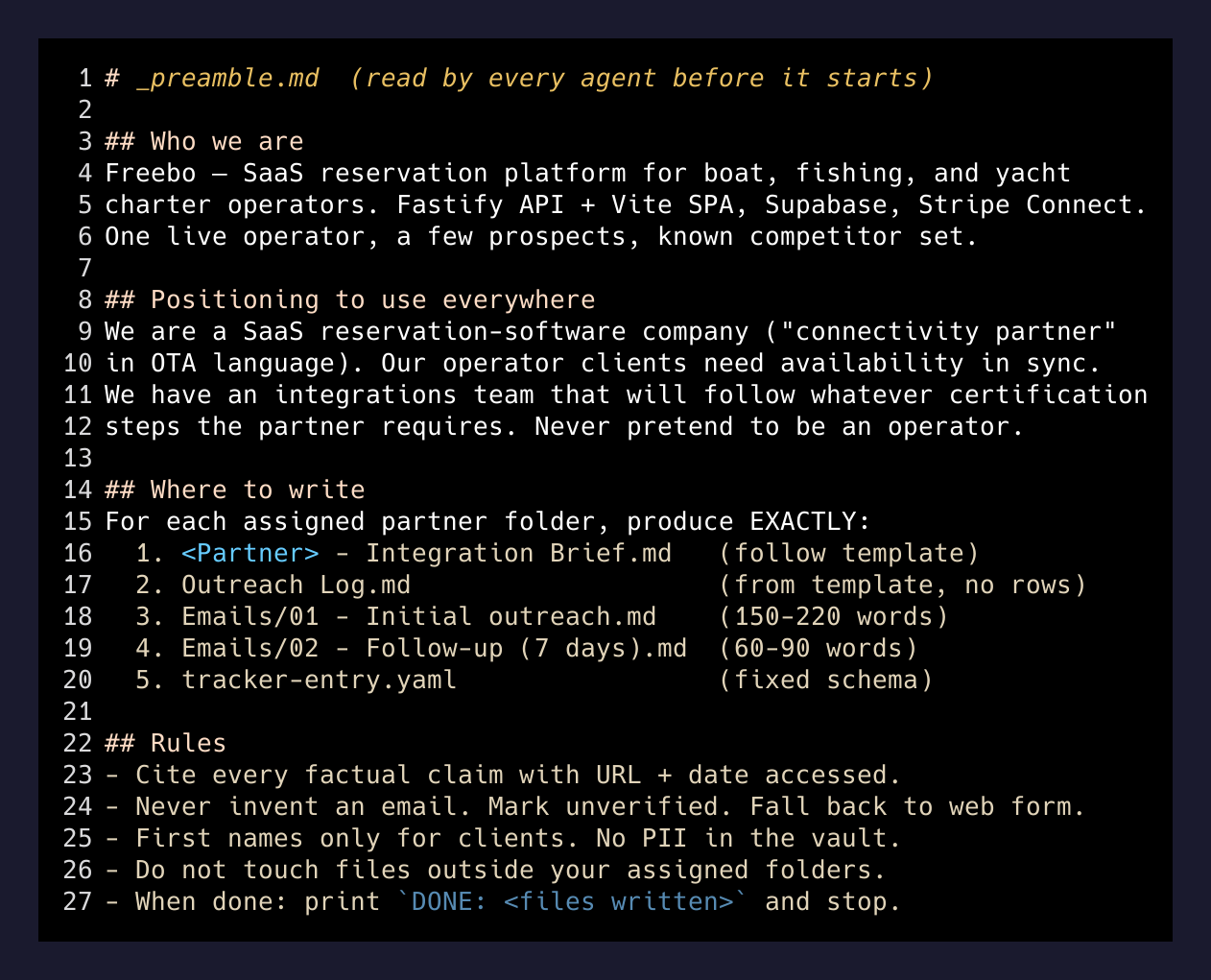
That’s the preamble. Every agent reads the same tiny file before it starts. Mine was 21 lines. It defined four things:
- Who we are. Freebo, one paragraph: SaaS reservation platform for charter operators, Fastify+Vite+Supabase+Stripe stack, one live operator, a couple of prospects, list of competitors in the space.
- The positioning to use everywhere. “We are a SaaS reservation-software company — ‘connectivity partner’ or ‘channel manager’ in OTA language. Some of our operators are already on the partner’s platform, some are not. We have our own integrations team and will follow whatever certification steps the partner requires.” Two sentences. Every agent ended up writing outreach emails in exactly that voice.
- Where to write. Every agent creates the same four files per partner folder: an Integration Brief, an Outreach Log, two email drafts (initial + 7-day follow-up), and a
tracker-entry.yamlwith a fixed schema. All against the same brief template. - The rules. Cite every claim with a URL and access date. Never invent an email — mark unverified ones and fall back to the web form. First names only for clients. Don’t touch files outside your assigned folders. Print
DONE: <files>and stop.
What actually came back
Sixteen folders. Each folder identical in shape:
10 Integrations/
├── 01 Viator/
│   ├── Viator - Integration Brief.md      (96 lines)
│   ├── Outreach Log.md                    (append-only paper trail)
│   ├── Emails/
│   │   ├── 01 - Initial outreach.md
│   │   └── 02 - Follow-up (7 days).md
│   └── tracker-entry.yaml
├── 02 FishingBooker/
│   ├── FishingBooker - Integration Brief.md
│   └── ...
The briefs are not fluff. One of them, for example, comes back knowing that the partner calls their program the “Supplier API” (reservation systems are “connectivity partners”), that the right intake address is a specific supplier-API mailbox, that access is gated to “operators registered with [the partner] and their authorized reservation system providers” — so development can’t start until at least one operator is live on both sides. It sketches the 8-phase onboarding, the operator-side “Connect Now” handshake in the supplier portal, the LinkedIn titles worth targeting on the connectivity team, and the exact set of API endpoints an integration has to implement.
That’s from one of sixteen files. All produced in parallel. All with source URLs cited inline.
The tracker YAML is the machine-readable seed the Hermes ops bot picks up next: status (research → ready-to-apply → applied → sandbox → live), priority, next action, follow-up window, and the Gmail search string that would catch a reply from that partner.
What I actually spent
The economic story is where this stops being a party trick and starts being a business tool.
A researcher on Upwork would quote this at $50-$100/hour and take five business days. That’s a low-four-figure line item plus a week of calendar. A junior at an agency would spend most of the week and produce something less structured, in Google Docs, with everyone’s voice bleeding through.
I spent about $8 in tokens (Sonnet-tier across five agents, roughly two million tokens including cache reads) and 16 minutes of wall time. The rest of my night was free. This morning the ops bot picked up the tracker YAML on its 08:05 CT cron, drafted the outreach emails as Gmail drafts from brett@freebo.ai, and left them waiting for me to approve-and-send.
The parallelism is the party trick. The preamble is the business.
— What I actually learned
The lesson worth taking
Every “AI agent” post you read is either five thousand words on prompt theory or a demo that solves a toy problem. The pattern that actually shipped my work is smaller than both:
Write a preamble that pins voice + schema + rules. Fan out to N agents. Merge.
If the outputs come back inconsistent, the fix is in the preamble, not the agents. Every time I’ve been tempted to add more supervision, more model tiers, more clever orchestration, the real fix has been to tighten the shared prompt. The preamble is the load-bearing wall — everything else is decoration.
I woke up this morning to sixteen partner briefs I would have spent a week writing myself. The next Freebo prospect I demo to already has the distribution map behind it, and I didn’t lose a day.
That is the entire point of running your own agents.