
Friday I approved a small batch of partner outreach — four emails, four OTA platforms, all going to the addresses those platforms publish on their supplier or connectivity pages. This is the same batch every reservation-software vendor has to send to get in the door. Nothing exotic.
Three of the four bounced.
0
emails sent
0
hard bounces
0
delivered
0
that alone opens the door
Not “went to spam” bounced. Not “sitting in a queue somewhere” bounced. 550 The email account that you tried to reach does not exist bounced. The advertised inbox is a ghost.
What actually happened
Four partners, four “official” addresses I pulled off their published docs or partner pages the week before:
supplierapi@viator.compartnerships@fishingbooker.comintegrator@getyourguide.comsupport-api@getyourguide.com(yes, GetYourGuide got two shots — a primary and a CC)
The Viator one delivered fine. The other three all hard-bounced within minutes with the same SMTP 550 flavor: no such user. Two of them were on the same domain from the same partner. Both dead.
If I had trusted the outbox and moved on, I would have spent the next two weeks patiently waiting for a reply from three inboxes that don’t exist. Then I’d chase a follow-up. Then I’d wonder why nobody at these companies “cares about partners.” Then I’d probably blog something bitter.
Instead I have three actual working paths in, because I went looking for the door on foot.
What the real door looks like at each
Here’s what actually routes a partnership request at each of the three:
FishingBooker. No public partnerships alias. The support-facing web form at fishingbooker.com/contact under Legal and business inquiries → Other is a live channel — I submitted the same body I’d emailed and got a “Your message has been sent!” confirmation from their app. The BBB listing also gives you a verified phone number I now know is real. The warm route is asking an existing operator to introduce you to their account manager, which is faster than either.
GetYourGuide. Both published inboxes are dead. What actually exists is a public Integrator Portal at integrator.getyourguide.com/home that you self-serve into. Sign up, accept the T&Cs, and you’re in the queue for the three-phase certification. There is no email path. Any support address only exists once your portal account does.
Viator. The email address supplierapi@viator.com is real and delivers. But it alone doesn’t route. The actual routing happens when an operator already on the platform goes into Account → Connectivity → Connect Now, types in the reservation-system name, and submits. That’s what puts the request in front of the connectivity team’s queue (2–3 business days per the docs). The email starts the conversation; the operator-side click is what makes it real.
The pattern
Three of these partners advertise a partner inbox on their public docs. Two of the three inboxes don’t exist. The one that does isn’t enough on its own.
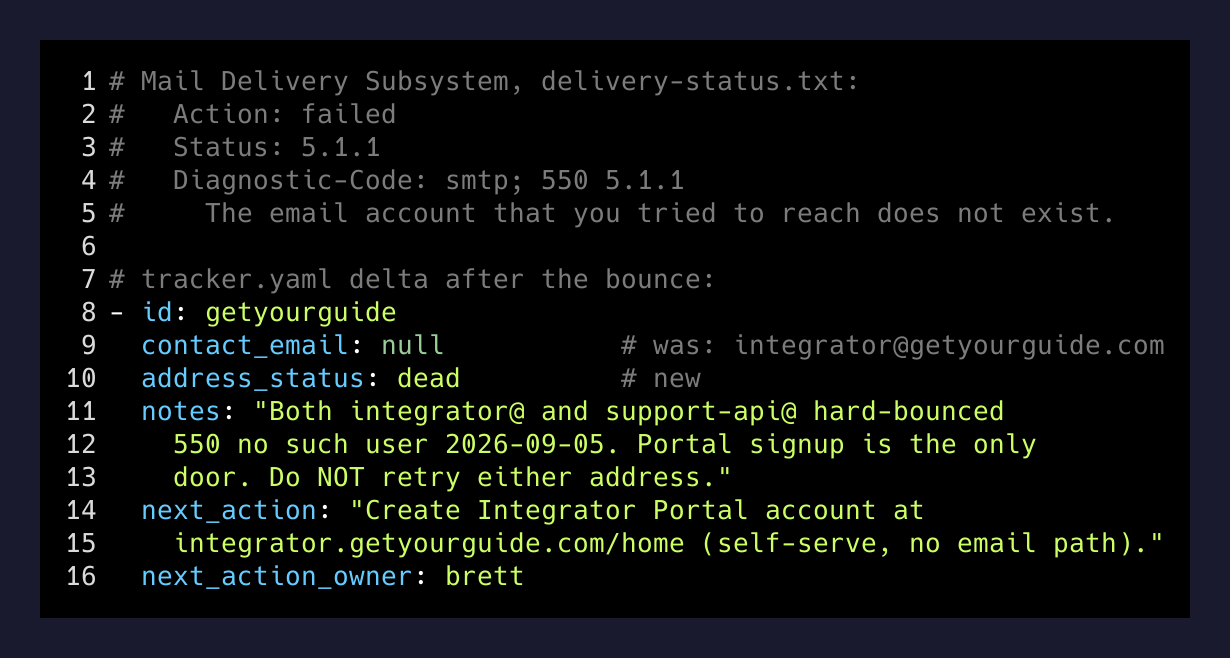
The pattern shows up so consistently that I now treat every advertised partner email as unverified until proven otherwise, and mark it that way in the tracker YAML for the outreach bot. The bot won’t send from a verified alias to an unverified inbox until it also has a fallback channel (form, portal, LinkedIn, warm intro) queued behind it. That way a bounce is a data point, not a blocker.
Doing the door check before you send
The fifteen minutes of legwork that would have saved me the bounces:
- Verify the MX + mailbox exists. A DNS check tells you the domain accepts mail; a lightweight SMTP handshake (RCPT TO with an immediate QUIT before DATA) tells you the specific address does. Most bounce-verification services do exactly this.
- Check the Better Business Bureau listing. For partners with a US business presence, the BBB page usually has a verified phone number and a verified corporate address, both more trustworthy than a five-year-old docs page.
- Cross-check LinkedIn. Search “connectivity partnerships” or “supplier API” at the company. A living team means the alias is probably still live; a team of ghosts is a red flag.
- Try the web form first if one exists. Contact forms route through a live ticketing system; email aliases sit on a mailbox somebody has to keep alive. The form is more likely to reach a human this quarter.
- Assume portal is the door if a portal exists. Whenever a partner has a self-serve developer or integrator portal, that’s almost always the fast path and the email is almost always vestigial.
Here’s what my four-partner grid looks like now, with what actually works alongside what the docs page said:
| Partner | Advertised inbox | Delivery | Real door | Verify with |
|---|---|---|---|---|
| Viator | supplierapi@viator.com | Delivered | Operator clicks Connect Now in their Supplier Center | Docs + operator handshake |
| FishingBooker | partnerships@fishingbooker.com | 550 no such user | Web form under Legal/Business → Other | BBB phone verification |
| GetYourGuide | integrator@ + support-api@ | 550 no such user (both) | Self-serve Integrator Portal signup | Portal exists; email doesn't |
Why this matters if you’re using an agent to draft outreach
The thing about turning an agent loose on partner outreach is that the agent is delightfully willing to keep sending drafts into black holes forever. It will follow up on day 7, escalate on day 14, and cheerfully write you a status report about “still awaiting reply” while the SMTP layer has been rejecting the messages the whole time.
The fix isn’t smarter drafting. It’s making bounce data flow back into the tracker as loud as the reply data does. My integrations desk now watches for Mail Delivery Subsystem bounces on any outbound with the same subject line and flips the address to dead in tracker.yaml. The next follow-up is auto-suppressed against that address, and the next-action gets rewritten to the fallback channel (form / portal / warm intro).
Every advertised partner inbox is unverified until a live human replies. Send the email, and in parallel work the form, the portal, the phone number, and the warm intro. First one to answer wins.
— The takeaway
The bigger lesson
Half the reason distribution is slow for a small SaaS isn’t that partners are hard to reach. It’s that the published way to reach them was true in 2022 and nobody at those companies remembers to check. The web is full of stale doorways. The living doors are almost always: a form, a portal, or a warm intro from someone the platform already trusts.
If you’re doing anything that looks like this — pitching an integration, applying for a program, asking for a review — treat the advertised path as a hypothesis, not a fact. Fifteen minutes of verification up front is cheaper than two weeks of politely following up with a mail server that’s been laughing at you the whole time.
I got three bounces on Friday. Three replaced with paths that actually go somewhere. That’s a good Friday.