 Life & Notes
A note on how this was written: I used an AI to help me draft this review. I went on a walk after finishing the book, dictated my thoughts out loud, then came home and went back through every chapter I underlined and highlighted and dictated more. Claude organized my words, I read it, edited it, rewrote parts, and read it again. Every thought here is mine — the AI just helped me get it on paper. I think that is how these tools should be used.
Part 1: How I Came to This Book
A Dead Man’s Final Argument
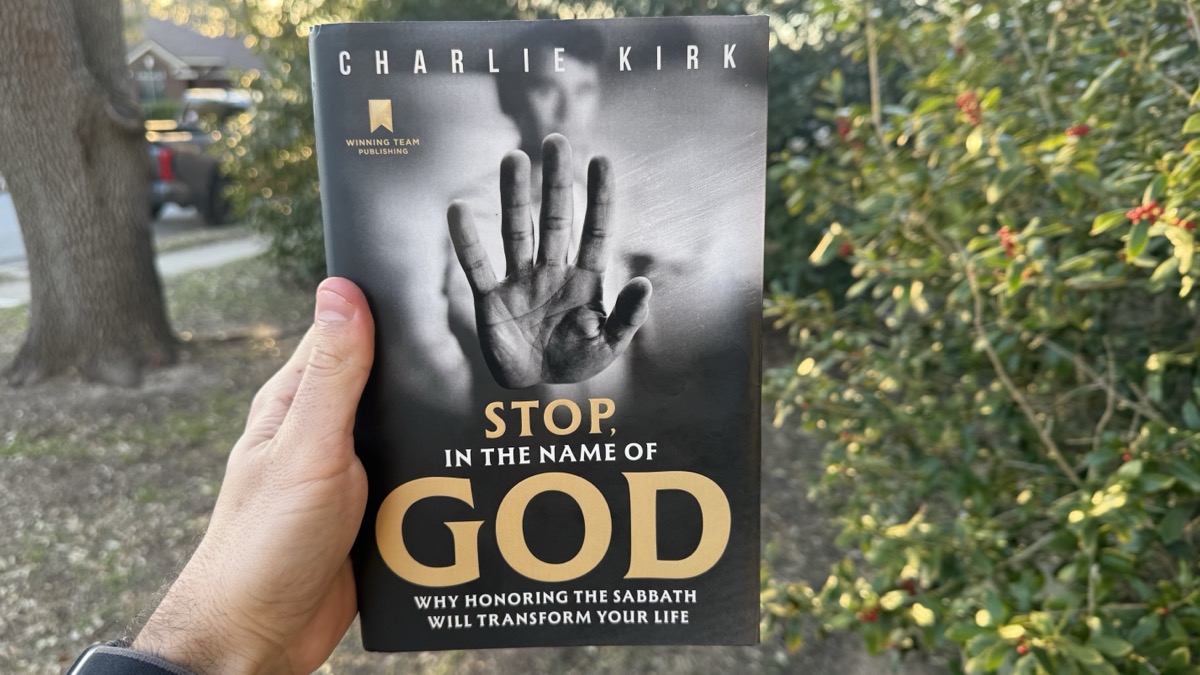
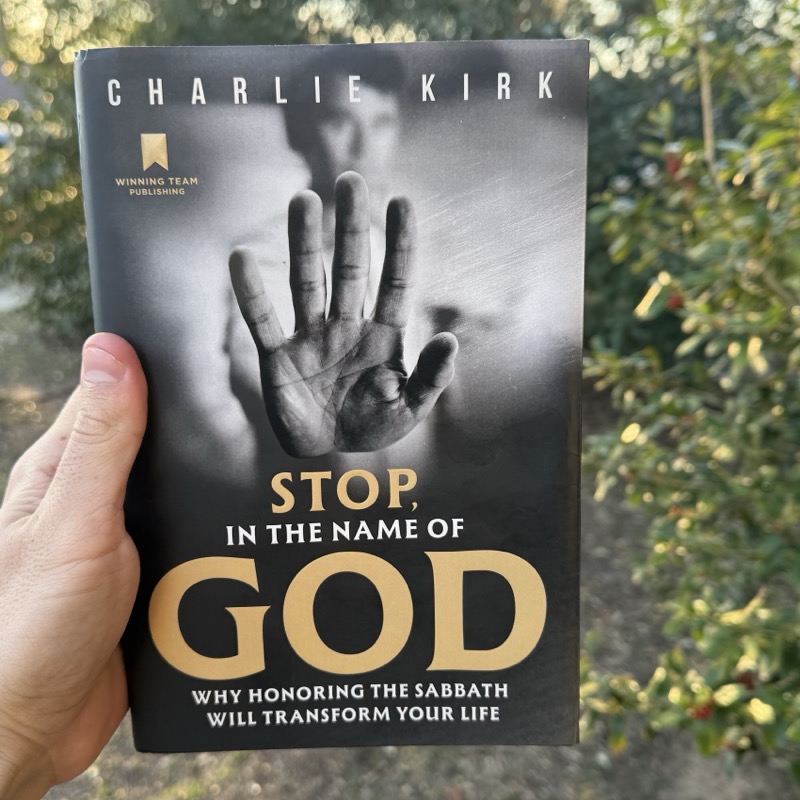
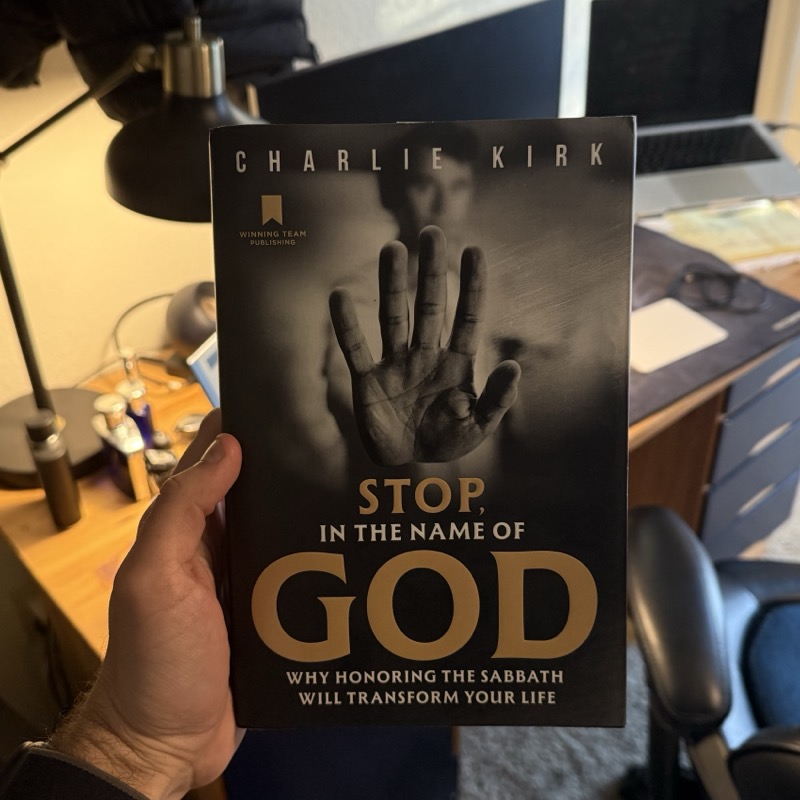
I did not expect to spend the last weeks of 2025 reading a book about rest. But my dad handed me Stop, in the Name of God: Why Honoring the Sabbath Will Transform Your Life by Charlie Kirk sometime in December, a few months after Kirk was fatally shot during a campus event at Utah Valley University on September 10, 2025. He was thirty-one years old. The book — his final work, completed just one month before his assassination after eighteen months of writing — was released on December 9, 2025, through Winning Team Publishing. It sold out at every Barnes & Noble in Utah on day one and shot to number one on Amazon’s Christian and religion charts. His wife Erika wrote the foreword.
There is something sobering about reading a man’s last words on paper when those words are about stopping. About resting. About trusting God enough to put it all down for a day. Charlie Kirk was not a man who rested easily — by his own admission in the book, he was hitting a wall, running on eight cups of coffee a day, with more obligations than time. And then he discovered what billions of people over thousands of years had already known and most of us have since forgotten: the Sabbath is not optional. It is not outdated. It is a command, and it is a gift.
But before I get into the book itself, I want to explain how I got here — not just how the book ended up in my hands, but the longer road that made me the kind of person who would actually read it.
The Debater on My Screen
I first encountered Charlie Kirk the way a lot of people my age did: through viral videos. He was the guy standing behind a table on college campuses with a sign that said “Prove Me Wrong,” debating students twice as loud and half as prepared. I started seeing these clips around late 2017 when I was in college myself. I knew him as the conservative guy. The Republican guy. The Turning Point USA guy. The anti-abortion guy. I knew he was Christian, though at the time that registered more as a political identity than a spiritual one. Ironically, his anti-abortion stances were actually some of the first inklings I had that his conservatism was rooted in something deeper — in faith — even if I did not fully appreciate that distinction yet.
I also knew him as the anti-porn guy, which was a position that quietly earned my respect even though I never said much about it. I knew plenty of people my age who actively watched pornography. I knew it was bad. I did not think much beyond that at the time.
Politically, I identified as Republican through my early and mid-twenties. My operating philosophy was straightforward: let people interact however they want in a free economy, and things will generally work out. I voted Republican. That was the extent of my political depth for a while.
Raised Catholic, Grateful and Gone
I was raised Catholic, and I am grateful for it — even though I did not always feel that way.
What I received as a kid was, frankly, a lot of forced education about Jesus. Flashcards on the twelve apostles. Greek and Hebrew in high school. Rosary prayers. Hours of structured time thinking about Christ whether I wanted to or not. I can remember praying with my dad since I was a little kid. We had a prayer that started with “Now I lay me down to sleep, I pray the Lord my soul to keep” — a line I would later hear in a Metallica song, of all places, and realize it had been living in me longer than I thought. After praying, we would go over what I think of now as our grateful batteries — gratitude lists, basically, before I had any idea that was a practice people wrote self-help books about. Looking back, that was a really good practice for a kid.
But then high school ended, and so did my Catholicism — at least for a while. That tends to happen when something is forced on you. You graduate and you want to do anything but the thing you were told to do for eighteen years. So I left.
The Highlight Reel
What followed was a stretch of years that I look back on with a complicated mix of gratitude and clarity. I did not finish my computer science degree. Instead, I backpacked through fifty-one countries. In my early to mid-twenties, I became a marketing and media buying expert — and it was that skill, oddly enough, that gave me the vocabulary to understand what social media had been doing to my brain.
Once you learn how attention economies work, you cannot unsee it. I realized that for years — through college, after college, across continents — I had been curating a highlight reel for people I did not actually care about. And I was not alone. A lot of people get suckered into caring about what their Instagram looks like, what other people are posting, who is doing what. It is a trap disguised as connection.
As I got older, I realized that the community that actually makes a difference is the one you interact with in person. Face to face. So I stopped posting on social media. Then I stopped consuming it. Eventually, I deleted my accounts entirely. I stood out in my age group for doing this — it was not common for a twenty-something to go dark — but the people who were actually involved in my life respected it.
Coming Back
In 2022, I started going back to church. Not Catholic this time — a non-denominational church. A lot of the same core beliefs, but without a lot of the legalism that had made faith feel like a chore when I was younger. I read a book called Everyone’s a Theologian, written for a Reformed Baptist audience, and it gave me a modern education on the different traditions and declarations within Christianity. Things clicked in a way they never had as a kid.
I have been a practicing Christian for the last five years now. I was baptized again as an adult — even though I had been baptized as a child — because this time it was my choice. And every step I have taken toward following the Bible, toward accepting Christ as my Lord and Savior, has proven its effect in my life. My relationships are better. My friendships are deeper. My mental health is stronger. Not perfect — better. Tangibly, measurably better.
And Then the Book
So here I am. Late 2025, early 2026, holding a book written by a man who is no longer alive. Charlie Kirk was a debater at heart — it is what made him famous and what made him polarizing — and in Stop, in the Name of God, he brings that same intensity to a topic most churches barely touch: the Sabbath. Whether you agreed with him politically or not, the man did his homework, and he was not afraid to make an argument.
What follows is my review of that argument.
Part 2: The Book
The Foreword
Before Charlie Kirk’s words even begin, you have to get through Erika Kirk’s foreword — and good luck doing that dry-eyed. She writes about the man behind the microphone, and the picture she paints is someone far more tender than his public persona suggested. One line in particular stayed with me: “He fought fiercely for freedom. Yet he also shepherded hearts with gentleness. He lived at a relentless pace, but he also knew the sacred value of stillness. And through it all, his gaze was fixed on eternity. More than anything, he longed for others to set their eyes there too.”
Reading the foreword of a posthumous book written by the author’s widow is a unique kind of heavy. It sets the tone for everything that follows. You are not just reading an argument about the Sabbath. You are reading the last project of a man who knew he had too much on his plate, found something that changed him, and spent the final eighteen months of his life trying to share it with the rest of us. He did not know he was running out of time. But reading it now, you cannot help but feel the weight of that.
The Setup: History, DNA, and a Case for God
Kirk opens the book the way you would expect from someone who spent years debating college students: he builds his case from the ground up. He does not assume you are a Christian. He does not even assume you believe in God. The first few chapters are his attempt to meet the reader wherever they are.
Chapter 1 starts with Genesis 1:1 — “In the beginning, God created the heavens and the earth” — and uses it as a launching pad to discuss creation, origin, and the foundation of everything the Sabbath is built on. Chapter 2, “Nothing Doesn’t Create Something,” goes deeper into the case for God’s existence, using DNA and the staggering complexity of biological design to argue that our existence is not accidental. It is the kind of chapter where you can feel the debater in him — marshaling evidence, anticipating the counterargument, closing the gap.
What surprised me was how well-researched the historical material was, even in the introduction. Within the first ten pages, Kirk references the French Republican Calendar, Nazi Germany, and Joseph Stalin’s Soviet Union — all examples of regimes that attempted to abolish or restructure the seven-day week and eliminate the Sabbath. It is a striking pattern: every time a government has tried to remove the rhythm God established, it has failed. Kirk does not just make this point in passing. He builds a case around it.
What Do You Worship?
Chapter 4, “What Do You Worship?”, was one of the sections that stuck with me the most. Kirk’s argument is simple and direct: everyone worships something, whether you know it or acknowledge it or not. You are worshipping something every day. For some people it is money. For others it is productivity, social status, their body, their career. The question is not whether you worship — it is whether you worship something worthy.
He follows this up in Chapter 5 with “Science, Stuff, and Power: The Age of Counterfeit Worship,” where he extends the argument to the idols of modern life. What I appreciated about these chapters is that Kirk anticipated exactly what a skeptical reader might be thinking and addressed it head-on. If you had objections, he had rebuttals. And if you did not have those concerns, the book still read well. It never felt like he was talking down to anyone — he was building his case the way a good debater does, brick by brick.
Saying No to Pharaoh
One of the threads that runs through the entire book is the idea that observing the Sabbath is not passive — it is an act of resistance. Kirk references Exodus throughout, including the command to let God’s people rest from their burdens. He frames it this way: to embrace the Sabbath is to say no to Pharaoh. And in our modern context, Pharaoh takes many forms — your inbox, your notifications, your boss’s expectations, the culture of constant availability.
By the time I was halfway through the book, Kirk had done something I did not expect: he convinced me that by taking the Sabbath, I would be declaring my freedom. As an American. As a Christian. As someone standing up to the tyranny of busyness. He literally makes you want to stand up, clap your hands, and go take a Sabbath. That is not an exaggeration. The man could write with the same energy he brought to a debate stage.
Sleep, Scottsdale, and the Way We Were Not Meant to Live
Chapter 7, “The Sabbath Improves Your Sleep,” was unexpectedly practical. Kirk makes the case that sleep is not laziness — it is a superpower. His line that stuck with me: “Jesus slept. Elijah slept. So can you.” It sounds almost too simple, but in context, after pages of evidence about what sleep deprivation does to the human body and soul, it lands.
He also takes an interesting detour in this section of the book to talk about mid-twenties to early-thirties single women in Scottsdale, Arizona, who own dogs instead of having families — his point being that this is not how we were meant to live. Whether you agree with the specifics of that cultural observation or not, his broader argument is clear: modern life has drifted far from God’s design, and the Sabbath is one way to course-correct.
Throughout all of this, Kirk keeps returning to the idea that God wants you to work. The Sabbath is not about being lazy six days a week and then resting on the seventh. It is about working hard, building, creating, engaging — and then deliberately, obediently stopping.
The Chapters You Do Not Have to Read (But Should)
There is a moment in the book where Kirk essentially tells the reader: you do not have to read the next two chapters if you do not want to, but you should. These are Chapters 9 and 10: “Are Christians Bound to the Sabbath?” and “Jesus Doesn’t Offer a Day — He Offers Himself.”
This is where the book gets theologically bold. A lot of Christians — myself included, based on what I had previously understood — operate under the assumption that many of the Old Testament laws were effectively set aside when Jesus fulfilled the law through His death and resurrection. The Sabbath falls into that gray area for a lot of believers. Kirk acknowledges this tension directly and then makes his case for why Christians are still bound to observe the Sabbath — not as legalism, but as a rhythm of life we were meant to follow. He ties it to the nature of Christ’s sacrifice: Jesus gave His life for us, and part of honoring that gift is trusting God enough to rest.
I found these chapters to be some of the most thought-provoking in the entire book. Kirk does not shy away from the theological complexity. He wades into it.
Action Items: What a Sabbath Actually Looks Like
The final stretch of the book — Chapters 11 and 12, “Now It’s Your Turn to Act” and “Sabbath Made Simple” — is where Kirk gets practical. He lays out what a Sabbath looked like for him, and what it could look like for you. The big elements are straightforward: take a full day, turn your phone off for twenty-four hours, and be present. He encourages readers to create a Sabbath start ritual — whether that is lighting a candle, putting on music, or some other intentional marker that says “this time is set apart.” Have screen-free meals with friends or family. Practice gratitude every day. Read a Psalm. Build a playlist. Go in peace.
He also encourages the reader to just try it for a month. Kirk recounts his own first experience observing the Sabbath, and it is disarmingly honest. He writes about waking up on that first Saturday around 7:30 AM, scrambling to check his text messages, frantic and worried that he might be missing someone or something critical. “What if President Trump calls me and my phone is off? What if my parents need to call me about an emergency?” This is what makes Kirk’s perspective on the Sabbath so compelling — he is not some monk living in the mountains. He is the kind of guy who actually might miss a call from the President of the United States. And he still turned his phone off. A day, a week.
The Conclusion: A Manifesto Against the Machine
The conclusion of Stop, in the Name of God is where Kirk’s writing reaches its highest gear. Reading it, you can feel the urgency of a man who has discovered something essential and desperately wants others to see it too.
He writes: “In a culture addicted to motion and noise, turning off your phone, quitting the scrolling, silencing Netflix, and stepping away from the endless stream of notifications is nothing short of radical. The Sabbath is not passive; it is a form of resistance. It is a rebellion against the idol of productivity and the tyranny of busyness.”
Kirk then turns his attention to technology and artificial intelligence — a section that feels almost prophetic. He warns that we are stepping into a future where AI will know us better than we know ourselves. It will anticipate our cravings, suggest what to believe, manage our calendars, and eventually raise our children — unless we push back. He argues that the ability to be fully present, to look someone in the eyes without a notification pulling your attention away, will become the rarest commodity on earth. Not oil. Not gold. Not data. Attention.
And then he offers the antidote: “Enter the Sabbath. The Sabbath is not just a nice idea. It’s not just a rest day for the religious or the nostalgic. The Sabbath is God’s answer to a culture spinning out of control. It is His ancient rhythm of sanity, planted like an anchor in a world swept away by currents of chaos. Six days we work, build, create, engage. On the seventh day, we stop — but not because we’re weak. We stop because we’re human. We don’t rest because we’re lazy. We rest because we’re obedient.”
The book closes with a call to action that is as direct as anything Kirk ever said behind a debate table: the gift of the Sabbath is right in front of you. Embrace it. Seize it. And stop, in God’s name.
Final Thoughts
I have started trying to observe the Sabbath since reading this book. My first real attempt was a screen-free evening after church on a Saturday, spent at Zury’s place with my girlfriend Haley and a few close friends — Zury, Colin, Jackie, and Jasper. No phones. Just food, conversation, and presence. It was simple. It was different from a normal hangout in ways that are hard to articulate but easy to feel. I plan to keep going.
Reading this book felt like spending time with two people at once — Charlie Kirk and God. Kirk made the introduction. God did the rest. There is something rare about a book that does not just inform you but changes what you do the following weekend. This one did that for me.
Who Should Read This Book
I would recommend Stop, in the Name of God to two groups of people in particular: Christians who do not yet observe the Sabbath, and non-Christians or skeptics. Kirk wrote this book knowing that not everyone picking it up would share his faith, and he structured his argument accordingly. If you are a believer who has never seriously considered the Sabbath, this book will challenge you. If you are not a believer but you are exhausted by the pace of modern life and open to hearing a case for something ancient and countercultural, Kirk makes that case better than anyone I have read.
Charlie Kirk finished writing this book one month before he was killed. He spent eighteen months on it. He was fiercely proud of it. And having read it, I understand why. It may be the most important thing he ever wrote.
Brett Ridenour is a 29-year-old entrepreneur, developer, and practicing Christian based in Austin, Texas. This review was written in January–February 2026.