
The first email in my inbox this morning was a Stripe receipt I did not generate. Underneath it, a Novu notification. Underneath that, a confirmation to a customer whose name I had never typed into anything. Somewhere between 2 a.m. and 5 a.m. Central, a stranger had bought a trip through a charter operator who runs on my platform, paid for it with a card I will never see, and the ledger had closed the loop before my coffee was ready.
Every founder has rehearsed this moment in their head. The first inbound booking that you did not personally stage. No demo button. No friend-of-a-friend. No “let me walk you through it on a call.” Just the money moving because the system worked.
I want to describe what the system actually did, because the fun part is not the feeling. The fun part is the chain.
The chain that had to fire
A booking looks like one event in a founder’s inbox. It is not. It is a dependency graph of eight or nine systems that have to agree, in order, without me being awake to referee any of them.
Any one of those steps can fail at 3 a.m. in a way that would delete trust with an operator forever. The design job is making sure that when they fail, they fail in a way that is recoverable rather than silent.
Why the webhook does nothing
The thing I am proudest of in this chain is also the most boring piece of code I have written for Freebo. The Stripe webhook route is three lines of real logic. It stores the event. It returns 200. It ends.
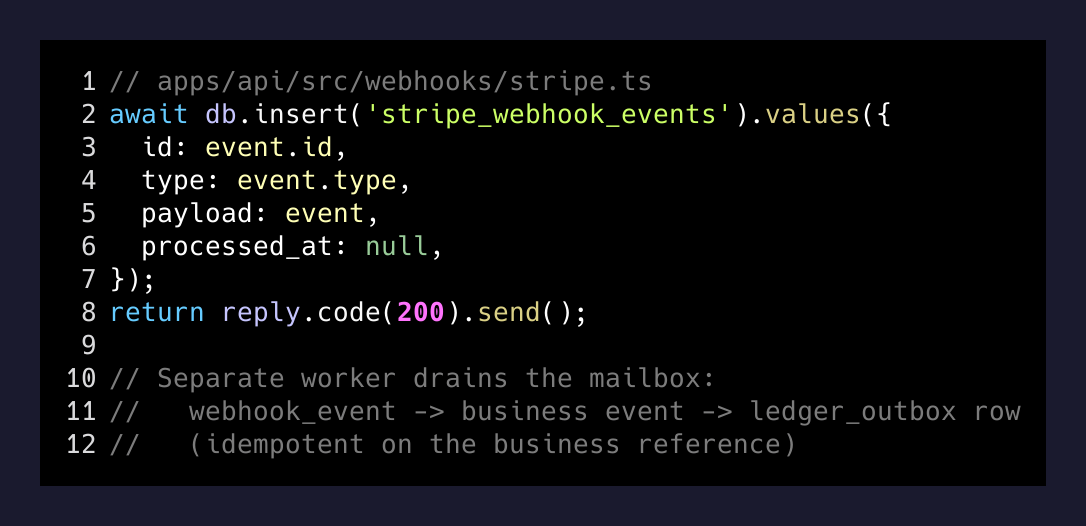
Nothing else runs synchronously. Not the ledger. Not the notification. Not the receipt email. If the webhook does real work, then any blip anywhere in the system means Stripe retries, which means duplicate ledger postings, which means the operator’s revenue number drifts, which means a Monday morning they do not deserve.
So the webhook is a mailbox. A separate worker reads the mailbox, decides what business event the Stripe event represents, and writes exactly one row into ledger_outbox with an idempotency key built from the business reference. The outbox is what actually drives Formance.
The payoff is that every piece of the system can crash, restart, lose its mind for an hour, and the only thing that matters is whether the outbox row exists and whether it has been posted. If both are true, you are done. If only the first is true, a recovery runner picks it up on its next tick. If neither is true, the Stripe retry will put it back in the mailbox and we try again.
Why I trust the number this morning
When I opened the operator’s dashboard this morning, the balance was right. Not “approximately right.” Exactly right, down to the cent, with the platform fee split out, the Stripe processing fee reflected, and nothing in a limbo state.
That is because the ledger is not a cache of Stripe. It is its own double-entry system. Every event has to balance. If the debits and credits do not match, Formance refuses to post it, and the outbox row sits there yelling at the recovery runner until a human looks at it. There is a specific endpoint I built just for this — GET /v1/locations/:id/financial-operations — whose only job is to show you what is pending, blocked, or quietly broken.
The best feeling in a solo SaaS is checking a number you did not have to calculate.
— Me, at 7:30 a.m.
A single real booking is not a business. I know that. But a single real booking that ran through a payment processor, a double-entry ledger, a notification queue, and an operator dashboard with no human intervention — and came out the other side with every row in the right place — is a working machine. Everything after this one is just more of the same shape.
What this one booking proved
Three things, in increasing order of how long I will sit with them.
The checkout v2 release did not break the money. We shipped a 290-commit promotion two days ago that included a redesigned checkout, a rewritten availability engine, and a one-time ledger conversion. The scariest change I will ever push, probably. Nothing in it caved under a real card at 3 a.m. That is more than a passing test suite can tell you.
Durable notifications are the thing operators actually feel. The operator did not log into my dashboard to find this booking. They got the email the moment it posted. Novu’s inbox and queue are the layer that turns the ledger from “a database” into “a product.” Before I built that queue, a crashed worker meant a missed reminder, which meant a missed trip, which meant a real human on a dock wondering where their customers were. Now the worst case is a slightly late email.
I can keep building things that do not need me at 3 a.m. That is the actual job. Not the booking itself, but the fact that the booking happened without me. Every system I add to Freebo should be judged by whether it makes that more true, or less. If it makes me need to be awake, I am building the wrong thing.
The receipt from Stripe is sitting in my inbox. I do not need to reply to it. I do not need to do anything with it. It is just a quiet little green checkmark that says the machine ran.
That is the whole point of the machine.